Showing posts with label movies. Show all posts

Monday, August 29, 2011

Meg Coburn, the forgotten action heroine

NOTE: THIS IS THE FINAL NEW BLOG POST AT THIS LOCATION. SUBSEQUENT BLOG POSTS WILL BE FOUND ON MY NEWLY REVAMPED WEBSITE AT ALEXBLEDSOE.COM.

I love action heroines. I've even put one in my next Eddie LaCrosse novel, Wake of the Bloody Angel. But my standards require, if not strict adherence, at least lip service to the laws of the natural world. That negates the whole concept of the the "ass-kicking sprite," wherein a tiny female character suddenly has the ability to overpower people (usually men) three times her size. No, my idea of an action heroine is someone like Xena, who has the physical size and strength to really do battle. And of course, the gold standard is Ellen Ripley in Aliens. She has no super, or supernatural, powers; she's merely tough, resourceful, determined and smart.

Which brings me to the great forgotten action heroine: Meg Coburn. Feel free to insert your own variation of, "Who?"


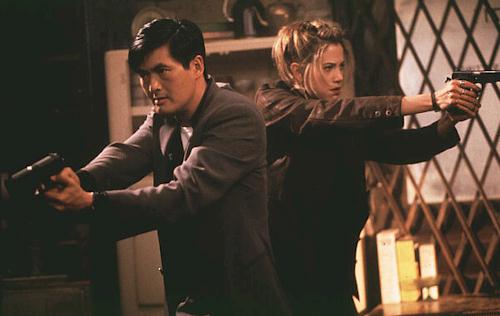
Meg Coburn, played by Mira Sorvino, was the heroine of Antoine Fuqua's 1998 film The Replacement Killers. Notable as the American film debut for Hong Kong star Chow Yun-Fat, it's a fairly simple story of hired killer John Lee (Chow), who decides he has a conscience after all. Meg Coburn is a forger he hires to make a new passport so he can return to China and protect his family. Unfortunately the bad guys intervene, putting Lee and Meg on the run together.

Two moments cement her appeal for me. One is visual: during the shootout in her first scene, she and Chow Yun-Fat arrive in the same room and drop into the same pose, only aiming in opposite directions. The image says it all: it's the mutual competence of equals. And in an action movie, if you're as competent as Chow Yun-Fat, you're doing all right.


The second occurs later, when John forces Meg at gunpoint to accompany him. She gives him a look that could freeze magma and says calmly, "Okay, if that's the way you want to play it. But when the gun is in my hand, we're going to have this conversation again."

There's a ton of other things that make Meg cool, but in some ways the things she doesn't do are more interesting. She never panics. She may yell, but she never once screams. She never stops trying to resolve the immediate situation. Yes, she's feminine and sexy, but it's incidental; there's only one fleeting shot I'd describe as actual Michael Bay-style pandering.

If you decide to see the film, seek out the "extended cut" DVD. Since it was made in 1998, when Hong Kong was about to revert to Chinese control, a crucial subplot was minimized in the theatrical release to avoid offending China and losing Chow Yun-Fat's hometown market. It's been restored here, and it fleshes out the motivations in a pretty substantial way.


It's obvious that we, the public, want different things from our heroines than from our heroes. It's why Supergirl dresses like a cheerleader, after all. But occasionally, amongst the pantings and leerings of the Bays and Favreaus, a real person slips through. Mira Sorvino's Meg Coburn was one of those. It's a shame more people didn't notice.

Monday, August 22, 2011

Love, Revenge and Conan: What's My Motivation?

NOTE: THIS IS THE NEXT-TO-LAST POST FOR THIS LOCATION. AT THE END OF AUGUST, THIS BLOG WILL NO LONGER BE UPDATED. MY BLOG WILL BE FOUND AT MY NEWLY-REVAMPED WEBSITE, ALEX BLEDSOE.COM.

So there's a new Conan movie. And, if the previews are any indication, Conan spends the movie on a quest for revenge against the villain(s) who destroyed his village and murdered his family.

I won't go into how many ways this deviates from the original Robert E. Howard character (short answer: a lot). Instead, it got me thinking about screenwriters and how they think.

Consider the idea of "motivation." In movies, heroes are usually motivated by either love or revenge. And they must have a definite, solid, entirely personal reason for doing anything. I first became conscious of this trope watching The Skeleton Key, eighty percent of a great horror movie. Caroline, played by Kate Hudson, talks about how she became a geriatrics nurse after watching an elderly relative slowly die from Alzheimer's.


"Ah-HA! My motivation! Now I can act!"

Really? So she couldn't be a person who looked at possible careers and chose one that sounded good, or wanted to have a job with security, or any of the reasons most of us choose our jobs? No, there had to be a hyper-dramatic, entirely personal reason so that the audience will "sympathize" with her.

Giving Caroline such a background smacks of a "Screenwriting for Dummies" lesson. Sure, characters need motivation. But screenwriters seem unable to accept that "earning a paycheck," "providing for my family" or most crucially "the satisfaction of a job well done" are acceptable motivations. If the line "this time it's personal" doesn't apply, then it isn't valid.

Except that it is.

Here are two examples from the work of Oscar-winning director/screenwriter William Friedkin. In his 1986 film To Live and Die in L.A., FBI agent Richard Chance (CSI's William Petersen) sets out to bring down villain Rick Masters (Willem Dafoe) after Masters kills his partner. He even blatantly states, "I'm gonna bag Masters, and I don't give a shit how I do it." It's a textbook--well, a screenwriting textbook--character motivation. This time it's personal, and it encompasses both love (of the bromance kind) and revenge. It keeps an otherwise excellent movie from being truly great.


Conversely, in Friedkin's 1971 film The French Connection, New York cop Popeye Doyle (Gene Hackman) stays tenaciously on the villain's tail because, simply, it's his job. He needs no ulterior motive, nothing that says "this time it's personal." Through the course of the story it becomes personal, but only because the villain's success reflects badly on his professionalism. His ego is tied to his job, and he simply can't let the bad guys win. There's no hint that a childhood trauma caused this, or that a gangster (or Frenchman) once killed his family, or any sort of trite justification. It's realistic, and it's one of the elements that helps make the film a classic.


There are many useful things novelists can learn from screenwriters: get to the point, keep the action moving, craft witty dialogue and so forth. But this is one lesson they should skip. So make sure that you take away the right lessons, and stay grounded in reality where there are many other motivations besides love and revenge.

But....

As I read over the above, I realized my perspective is entirely one-sided. So for another point of view, I asked writer and USC film graduate Melissa Olson to comment on what I'd written so far. She responded:

"When I was at USC, nobody dreamed of being the next Michael Bay (well, maybe in the directing track(:). Everyone dreamed of telling the story they wanted to tell, to make the statement they wanted to make. But once you get out of school, the film industry is a tough business.

"Screenwriting is complicated, and in many ways it’s much more restrictive than novels. Maybe the screenwriters of
Conan (there were three) didn’t want the movie to be about motivation; they wanted to get that out of the way and tell a different story. Shortcuts aren’t terrible things, they’re just easy ways out. Sometimes you gotta take one to get to where you want to go."

So there's two sides to this. What do you, the reader/filmgoer, think?

Monday, July 18, 2011

Review: the anti-western Doc

I love movies about the 1881 showdown in Tombstone, AZ between Wyatt Earp and the Clanton gang. My favorite is Tombstone, but I won't sleight Gunfight at the OK Corral, My Darling Clementine, or Hour of the Gun (which actually starts with the gunfight and follows the events afterward). I can't stand Kevin Costner's epic, sprawling Wyatt Earp, which demythologizes the central character to the point that you actually wonder why anyone would make a movie about him, yet still holds him up as a hero.

But it ain't nothing compared to the demythologizing in Frank Perry's 1971 film, Doc. Even the poster brags about the tear-down:

Stacy Keach plays Doc Holliday, former dentist and current tubercular gambler, drifting across Arizona to join his friend Earp in Tombstone. Earp is played by Harris Yulin, a ubiquitous character actor who you'll instantly recognize even if the name doesn't register (he even played a Cardassian in Deep Space Nine). Also co-starring is Faye Dunaway as Kate Elder, aka "Big Nose" Kate, Doc's mistress.

With Doc as the central character, we're given the legend from the side. Earp may be the marshall, but he recognizes that in Tombstone, it's the sheriff who runs things. He runs for that office, and makes a deal with the Clanton gang to turn over one of their own at the appropriate time to secure Earp's victory. This view of Earp as not just a brutal man but a corrupt one leaves Costner's arrogant misanthrope in the dust. Doc is Earp's friend, but when he realizes what Earp's done he's caught in a quandary. How that resolves is one of the most cynical depictions of human nature I've seen; it makes Glengarry Glen Ross look like Amelie.


Stacy Keach and Faye Dunaway.

But unlike the Costner film, which seems to think Earp is still deserving of heroic status even after he's shown to be pretty much a total prick, Doc earns its cynicism. Doc is a flawed man who sees himself honestly, and allows himself a brief respite of thinking his life might be salvageable despite his tuberculosis. When he realizes it isn't, he goes with the flow and accepts his fate. The story takes place in a Western world that goes Sergio Leone one better: everyone is dirty and dusty, and at times you can almost smell their unwashed bodies. And the music, by songwriter Jimmy Webb ("MacArthur Park") is low-key and based in period sounds; there's no Elmer Bernstein flourish here.


Harris Yulin as Wyatt Earp.

Doc isn't a feel-good Western, for sure, nor a flawless one: many scenes seem cut too early, as if they needed another few moments to play out. But Keach's performance is so open and minimal that it draws you in, and Yulin's take on Earp never fails to surprise. If you're a fan of Westerns, or just of familiar tales told in new ways, I highly recommend it.

Monday, January 17, 2011

Thirty years of Excalibur


Thirty years ago the Arthurian myth first grabbed hold of me when I saw Excalibur on its initial release. Prior to that, I'd encountered King Arthur only through the Disneyfied Sword in the Stone, or the bloodless Technicolor epic Knights of the Round Table. John Boorman's 1981 film was different: limbs were hacked off, breasts were bared and there was a timeless sense of a blood-and-thunder past throbbing with life. Sure, it was stiff in places, and the acting was stylized to the point of ridiculousness, but it was still a movie in the pure sense, loaded with unforgettable images.

Thirty years on, I still love the film, and not just for sentimental reasons. There's a sure hand at work, one that knows exactly what it wants to accomplish with every shot and sequence. Boorman, who'd once tried to wrangle Lord of the Rings onto the screen as a live-action epic, is a fearless filmmaker as notable for his daring successes (Deliverance) as his audacious failures (Exorcist II: The Heretic). He depicts Arthur not as a neat or elderly monarch, but with the long hair and scruffy beard of a biker. Guinevere is an earthy princess who knows herbal remedies as well as courtly dances. Lancelot, in gleaming silver armor, has the curls and square jaw of a laid-back surfer. Boorman uses green backlight to give even the metal armor a hint of the organic, most beautifully during the emergence of the sword from the lake. The actors don't perform so much as embody their roles, as the film tends to show them only at moments of high emotion.


But the wild card is Nicol Williamson as Merlin. Whatever the behind-the-scenes process that arrived at this interpretation, Williamson is both the focal point and the most entertaining thing in the film. Using every possible range of his voice, clad in a silver skullcap and black ragged robes, he's a buffoon one moment, a sage the next, and never less than enthralling. Whenever the film seems about to take itself too seriously, Williamson saves the day with a pratfall or a goofy line reading.


I can understand why contemporary viewers might find it overblown and silly. In an age of ironic detachment, when everything has a wink-wink element, the worst offense is to take something seriously, and to unapologetically present a unique vision.

Excalibur does exactly that. And if you let it cast its spell (which goes something like, "Anál nathrach, orth’ bháis’s bethad, do chél dénmha") I think you'll find yourself watching it again in another thirty years, too.

Friday, December 3, 2010

Meet the Queen of the Lot

This is the final post on films I watched over the Thanksgiving holiday. I watched other films (Leatherheads, Pandorum, Coffee and Cigarettes), but there isn't much to say about them. I'm ending on a high note, though.


A while back I stumbled across the work of Henry Jaglom, a filmmaker who's been forging his own indie path for forty years. He existed on the periphery of my cinema consciousness until I saw Last Summer in the Hamptons on cable and suddenly realized here was this totally original artist, untouched by any popular trends, with a consistent (and consistently fascinating) body of work.

His latest film is Queen of the Lot, a follow-up to 2006's Hollywood Dreams. Both star Tanna Frederick, an actress notable for her total emotional clarity; she communicates everything her characters feel with her whole being. There's a moment in her previous collaboration with Jaglom, Irene in Time, that is probably one of the most amazing bits of non-acting acting I've ever seen. For her to have such a response, she would have to genuinely feel the moment to a degree most film actresses wouldn't dare, and couldn't pull off.

In Queen, Tanna is back as Margie Chizek, an actress on the make who hides a will of steel behind a "gosh-shucks" Iowa farmgirl exterior. Yet the Iowa farmgirl isn't exactly a put-on, either. As "Maggie Chase," she's the star of a successful action franchise, and is dating a hot established star, but wants more (she compulsively checks her Google points). She's also under house arrest after two DUIs in one week.

Jaglom's films are as much about locations as they are characters, and the film divides itself between two main spaces: the opulent home of Margie's managers (Zack Norman and David Proval), and the family homestead of her boyfriend Dov (Christopher Rydell), scion of a fading clan of Hollywood royalty. In the first setting Margie knows her role; in the latter she's afloat, especially when she meets her boyfriend's normal, sane brother Aaron (Noah Wyle). She gets into everyone's good graces by taking them at face value, something these crass, jaded, sophisticated people almost can't comprehend. But is she showing her true face to them?


That probably makes the film sound more serious than it feels, because ultimately it's a pretty amusing story. Jaglom's improvisational methods allow the actors to essentially make up the dialogue as they go, and since many of them are playing performers as well, they know the territory. Frederick and Wyle have great chemistry together, and though she's the star, he becomes the story's center; he sees through Margie, but at the same time responds to the parts that feel genuine, just as we do. A real surprise is Jaglom's daughter Sabrina, who gives genuine bite to her performance as a resourcefully conniving teen.

But the show belongs to Frederick. Jaglom tends to make his films around specific actresses; he had an extraordinary run with his wife Victoria Foyt, and his collaborations with Frederick have brought him into new territory. He's found a context for her unique energy and given her strong co-stars to bounce off, something many filmmakers (and actresses) would avoid. As for Frederick, she brings a level of emotional intensity and honesty to Margie that feels at times like a documentary. I've never seen another performer consistently seem so absolutely unaware of the camera's presence and risk the kind of things she does.

I'd love to see Jaglom and Frederick revisit Margie every few years, in between other projects like Irene in Time. If the funny, touching Queen of the Lot is any indication, the character and milieu are far from exhausted, and Ms. Frederick remains a wonder to watch.

Wednesday, December 1, 2010

Do I want to know Me and You and Everyone We Know?


Madison, WI poet Lisa Marie Brodsky recommended Miranda July's 2005 film Me and You and Everyone We Know, and I finally watched it over the holiday weekend. It's an indie film in the broadest sense, made by an outsider artist and about outsider people, some of whom do things so confoundingly odd that you wonder if they exist anywhere but in a film like this.

It's a film about relationships, about people reaching for meaningful connection in all the wrong ways. The central character, Christina (Ms. July), is a conceptual artist who sends positive messages out into the universe in the (so far) vain hope that they might bring love and happiness into her own life. She meets Richard (John Hawkes), a divorced father of two who barely functions and perpetually looks quite literally stunned. Richard's two children have inherited this inability to make appropriate decisions about closeness, leading them to odd connections with some of the other characters. It's one of those films where everyone turns out to be far less than six degrees away from everyone else, whether they know it or not.

July herself, as Christine, is a touching screen presence, so delicately lost and lonely that her art-inspired attempts to reach out seem incredibly brave. As a writer, she has penned not just this script but a collection of short stories, and knows how to structure multiple narrative lines so they flow and resonate. And as a director, she gets amazingly unaffected performances from the younger actors.


The issue I had with the film was how I felt about some of these connections. It's clear what the movie wants me to think, as every shot and music cue is used to cast a wistful, hopeful glow over things that perhaps shouldn't be considered as such. Some of the connections--for example, between a first-grader and an unknowing adult woman via online sex chat--are just inherently uncomfortable, and no amount of sensitive scoring or empathetic performance can overcome that. So I tried to decide: do I give in and feel what the film wants me to feel, or do I stay true to my own deep-seated and possibly Philistine responses despite my wish to like the film's view of the world?

Speaking of these same issues, Rogert Ebert in his review says, "I know this sounds perverse and explicit, and yet the fact is, these scenes play with an innocence and tact that is beyond all explaining." In Variety, Scott Foundas says these things "...sound puerile or even irresponsible, then it is all the more to July's credit that she embellishes such moments with a whimsy and melancholia that makes them seem less about sex than about making meaningful connections with other human beings." So should I admire this, the way Jessica Winter does in the Village Voice ("...July ascribes sexuality to persons under the age of consent without coyness or moral hectoring") or should I go with my emotional reaction, driven by my feelings as both a parent and a writer ("The movie engendered the kind of uncomfortable, crawling-out-of-your-skin feeling I get when I'm subjected to bad performance art," as said by Sam Adams in Philadelphia's City Paper).

Even after a few days pondering it, I'm still not sure. I know what Ms. July wants me to feel; I just don't know if I'm ready, willing or able to feel it. I asked Ms. Brodsky, who'd originally recommended the film, for her thoughts and she summed it up pretty well: "Miranda July is a brilliant voice in contemporary literature and film. She seems to do everything. She'll also make you squirm in your seat with the uncomfortable truth, so beware."

Monday, September 22, 2008

In defense of Superman Returns


Over at the science fiction blog io9, hardly a week passes that doesn't involve a dig at Bryan Singer's 2006 film Superman Returns. For example:

Warner Brothers Takes the Time to Make a Superman That Won't Suck.

Next Superman Movie Will Have Actual Superheroics.

How to Make You Believe a Man Could Fly Again.

While some criticisms are valid (a too-slavish devotion to Richard Donner's interpretation, an emphasis on "rescue-action" instead of a superheroic throwdown), I think the good folks at io9 do the film a disservice. And I have a different idea about why the film might not work for the average audience thrilled with Iron Man and The Dark Night. I think it's because Superman Returns is the first superhero film to really deal with adult issues.

Consider the plot stripped of its super-ness. A well-intentioned but somewhat naive hero has a one-night stand with the girl of his dreams, then gets some news from home. He leaves without saying goodbye, and is gone for five years. When he returns, his dream girl has moved on to a long-standing relationship with another man with whom she now has a son. This new man is decent, loves her and the boy, and more importantly has stayed around when our hero skipped out. In a crisis, this new man proves every bit as courageous as our hero, so that when the boy's true paternity is revealed (to only the mother and our hero), our hero faces his toughest choice yet. Should he reveal the truth and risk ruining everyone's lives? Or should he suck it up, accept that the situation is entirely his own fault and keep his mouth shut to spare good people more pain?

That's the core plot of Superman Returns, and it's a very specific dilemma for our hero. It's also a very specific dilemma faced by blended families throughout the world. As both a father and a step-father, it speaks to me with more emotional clarity than any of the so-called moral dilemmas in a film like The Dark Knight. In that film, Batman and the other characters have to choose between right and wrong; in Superman Returns, Superman has no "right" choice. That's much more like the real world than any other recent comic-book film.

And I don't think this sort of dilemma connects with the average vocal, blog-commenting super-hero fan, the ones who made The Dark Knight the second-biggest film in history. At the risk of being smacked for generalizing, most are young, most are probably not yet parents, and the majority of their toughest life choices are ahead of them.

I love Superman Returns, and I'm not ashamed to say so. Even if Bryan Singer, Brandon Routh and company are kicked off the next film and the entire series is rebooted to be more in line with the "dark" trend current among these movies, I'll still think it's awesome. And when little Jason runs back to give injured Superman a kiss, I'll still choke up every time.

Monday, June 16, 2008

First post

Never had a blog before. Never thought anything I'd have to say would be that interesting. Still not sure it will be. But it's the wave everybody else is already riding, so I'm belatedly climbing on the surfboard. I'm the guy with his beach sandals over his black socks.

I'll post mainly about writing (mine and other people's), movies and occasionally TV. Probably won't say much about politics, religion, or the weather; you have to come visit to hear about those things. I won't post for the sake of posting, or when I feel I have nothing to say. No promises that what I do have to say will always be fascinating.

This blog's title is a reference to the Bruce Springsteen song "Lucky Town," off the album of the same name. It's where I feel I've finally ended up, even though I secretly don't deserve it. Those responsible know who they are, and know how much I treasure them.

And so here I am, from down in Lucky Town. Thanks for stopping by.