Showing posts with label heroes. Show all posts

Monday, August 29, 2011

Meg Coburn, the forgotten action heroine

NOTE: THIS IS THE FINAL NEW BLOG POST AT THIS LOCATION. SUBSEQUENT BLOG POSTS WILL BE FOUND ON MY NEWLY REVAMPED WEBSITE AT ALEXBLEDSOE.COM.

I love action heroines. I've even put one in my next Eddie LaCrosse novel, Wake of the Bloody Angel. But my standards require, if not strict adherence, at least lip service to the laws of the natural world. That negates the whole concept of the the "ass-kicking sprite," wherein a tiny female character suddenly has the ability to overpower people (usually men) three times her size. No, my idea of an action heroine is someone like Xena, who has the physical size and strength to really do battle. And of course, the gold standard is Ellen Ripley in Aliens. She has no super, or supernatural, powers; she's merely tough, resourceful, determined and smart.

Which brings me to the great forgotten action heroine: Meg Coburn. Feel free to insert your own variation of, "Who?"


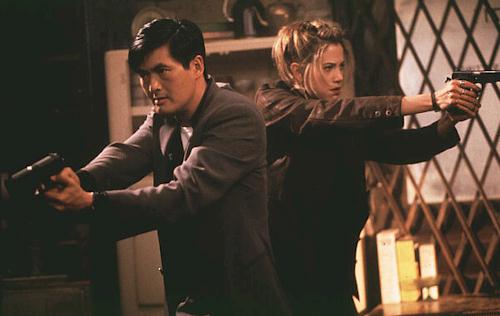
Meg Coburn, played by Mira Sorvino, was the heroine of Antoine Fuqua's 1998 film The Replacement Killers. Notable as the American film debut for Hong Kong star Chow Yun-Fat, it's a fairly simple story of hired killer John Lee (Chow), who decides he has a conscience after all. Meg Coburn is a forger he hires to make a new passport so he can return to China and protect his family. Unfortunately the bad guys intervene, putting Lee and Meg on the run together.

Two moments cement her appeal for me. One is visual: during the shootout in her first scene, she and Chow Yun-Fat arrive in the same room and drop into the same pose, only aiming in opposite directions. The image says it all: it's the mutual competence of equals. And in an action movie, if you're as competent as Chow Yun-Fat, you're doing all right.


The second occurs later, when John forces Meg at gunpoint to accompany him. She gives him a look that could freeze magma and says calmly, "Okay, if that's the way you want to play it. But when the gun is in my hand, we're going to have this conversation again."

There's a ton of other things that make Meg cool, but in some ways the things she doesn't do are more interesting. She never panics. She may yell, but she never once screams. She never stops trying to resolve the immediate situation. Yes, she's feminine and sexy, but it's incidental; there's only one fleeting shot I'd describe as actual Michael Bay-style pandering.

If you decide to see the film, seek out the "extended cut" DVD. Since it was made in 1998, when Hong Kong was about to revert to Chinese control, a crucial subplot was minimized in the theatrical release to avoid offending China and losing Chow Yun-Fat's hometown market. It's been restored here, and it fleshes out the motivations in a pretty substantial way.


It's obvious that we, the public, want different things from our heroines than from our heroes. It's why Supergirl dresses like a cheerleader, after all. But occasionally, amongst the pantings and leerings of the Bays and Favreaus, a real person slips through. Mira Sorvino's Meg Coburn was one of those. It's a shame more people didn't notice.

Tuesday, January 13, 2009

Underworld's Hero

With the upcoming release of the latest vampire vs. werewolf film, Underworld: Rise of the Lycans, I've been pondering my inexplicable affection for the first two Underworld films. By all rights I should hate them: at first glance they're surface-intense, drama-light, filled with inconsistencies and missed dramatic opportunities. They use the tattered trope of sexy, leather-clad vampires and sexy, hairy-bodied (and oddly all-male) werewolves. They're Twilight for the fetish set.

Some people close to me think it's all strictly because of Kate Beckinsale.


I dispute that, though: Ms. Beckinsale has been in some of the worst movies I've seen, such as Serendipity, Pearl Harbor, Van Helsing, Click and Brokedown Palace. She is attractive, certainly, but she's a Hollywood actress and that's part of her job. Praising an actress for being beautiful is like complimenting a doctor for knowing anatomy.

Instead, I think it's her Underworld character, Selene. In the story that encompasses the first two films, she is undeniably the hero. Not, let me point out, a heroine, which is a designation that insists upon gender. She is the hero.

This is what makes the Underworld films different. They completely invert the sexual dynamic of the standard action movie. Michael (Scott Speedman) takes the traditional "girl" role, constantly in danger and in need of rescuing. Even when he develops his own powers he still needs saving, and in both films it's Selene, not Michael, who confronts the main villain. She does so in the first film specifically to save Michael, and in the second film without Michael's help.


Not that she doesn't show physical weakness; she is a vampire, after all, and can be (temporarily) hurt, or destroyed by the sun. But she shows no stereotypically female emotional weakness. No betrayal or surprise is enough to cause her to crumble. She defeats physically stronger opponents with speed and skill, and suffers injuries when these aren't enough. She is, in fact, an antidote for every adolescent-fantasy, over-the-top caricature played by Milla Jovavich, Angelina Jolie, Jennifer Garner, Sarah Michelle Gellar or Summer Glau. Yes, she's sexy in that black leather suit (or out of it), which certainly doesn't hurt. But what makes her unique is that beneath the sexiness and fetish gear, she's a hero.

I'm not really looking forward to the new Underworld film, mainly because director Len Wiseman has stepped aside for newcomer (and former special-effects guru) Patrick Tatapoulos. And because it's a prequel there's no Selene, although casting Rhona (Doomsday) Mitra as the heroine is about as close as you can get without actually using Kate Beckinsale. Still, we know how this story ends: it forms the background for the first two films. Like every prequel, it's ultimately pointless.

I'll give it a shot, though, to see if the Underworld magic is still there. And if not, that's okay. Underworld and Underworld: Evolution tell a complete story about a hero who sheds her illusions, determines her own fate and finds love on her own terms. And if she looks good in black leather doing it, that's a bonus.

Sunday, August 3, 2008

Heroes: the Dragon Hunter

I don't have a lot of real-world heroes as an adult. There are people whose work I admire, and whose accomplishments I find impressive, but for me a hero is about being as much as doing. The late Steve Irwin and Charlton Heston were heroes; among the living, Bruce Springsteen and George A. Romero currently qualify.

But no one is a hero the way they are when you're a kid. I grew up before the new wave of historical revisionism that provided much needed context for the allegedly "heroic" deeds of our forefathers. Back then, Columbus was a great explorer and Andrew Jackson was a brilliant leader; their genocidal crimes against native populations were considered the cost of doing business and never mentioned. But one of my childhood heroes survived this sea change in how explorers and leaders were judged, and remains one of my heroes both for his accomplishments, and for the kind of man he was: Roy Chapman Andrews. And a recent (2001) book does a great job explaining why.


In Dragon Hunter : Roy Chapman Andrews and the Central Asiatic Expeditions, Charles Gallenkamp tells of Andrews' trips into the Gobi Desert of China in 1922-1930, leading expeditions in search of fossils and other scientific information. Among the many significant discoveries were the first confirmed fossilized dinosaur eggs. At the time, it was the equivalent of the moon landing in popular culture, and everyone knew of Andrews and his work:


Half a century later, his desert-traipsing bravado, encyclopedic knowledge and snappy headwear helped inspire one of the great movie heroes, Indiana Jones.


What Dragon Hunter explains, though, is how much real courage and resourcefulness Andrews demonstrated behind the scenes, negotiating with the Chinese government both before and after the encrouchment of Communism. Andrews, a native of Beloit, WI, adored Asia, learned its languages and customs, and had nothing but contempt for both the desert warlords and the later Communist bureaucrats. He saw both as exploiters of China's people and resources. He also compiled one of the first comprehensive studies of the world's whales, functioned as a spy for the U.S. during World War I, was president of the famous Explorers' Club, and found time to write books both for adults and children.


I owned All About Dinosaurs, written in 1953, when I was a child in the early Seventies. Chapman described his Mongolian expeditions in simple, exciting terms, concentrating on the battles with the elements and the discovery of huge numbers of fossils. There were no politics, only the hands-on wonders of exploration. It crystallized my love of dinosaurs, even though at the time its science was already fifteen years out of date. Under its spell, I wrote to Andrews at the Museum of Natural History, and experienced the kind of disappointment only a child can feel when the letter was returned marked DECEASED (Andrews died in 1960).

Andrews was not without flaws; he was, after all, a real person. But he stayed true to his principals until the end of his life, by all accounts tried to always do the right thing, and enjoyed both the respect and envy that only true pioneers can inspire. More importantly, he inspired others to follow in his footsteps. Now that I'm facing middle age in a world where heroes are in shockingly short supply, it's nice to be reminded of someone like Andrews. He did his job, remained a decent human being and, in his own way, changed the world.