Monday, September 12, 2011
New blog! New website!
Go here to visit my new website and a new blog. This blog will no longer be updated after this post. See you in my new digs!


Monday, August 29, 2011
Meg Coburn, the forgotten action heroine
NOTE: THIS IS THE FINAL NEW BLOG POST AT THIS LOCATION. SUBSEQUENT BLOG POSTS WILL BE FOUND ON MY NEWLY REVAMPED WEBSITE AT ALEXBLEDSOE.COM.
I love action heroines. I've even put one in my next Eddie LaCrosse novel, Wake of the Bloody Angel. But my standards require, if not strict adherence, at least lip service to the laws of the natural world. That negates the whole concept of the the "ass-kicking sprite," wherein a tiny female character suddenly has the ability to overpower people (usually men) three times her size. No, my idea of an action heroine is someone like Xena, who has the physical size and strength to really do battle. And of course, the gold standard is Ellen Ripley in Aliens. She has no super, or supernatural, powers; she's merely tough, resourceful, determined and smart.
Which brings me to the great forgotten action heroine: Meg Coburn. Feel free to insert your own variation of, "Who?"

Meg Coburn, played by Mira Sorvino, was the heroine of Antoine Fuqua's 1998 film The Replacement Killers. Notable as the American film debut for Hong Kong star Chow Yun-Fat, it's a fairly simple story of hired killer John Lee (Chow), who decides he has a conscience after all. Meg Coburn is a forger he hires to make a new passport so he can return to China and protect his family. Unfortunately the bad guys intervene, putting Lee and Meg on the run together.
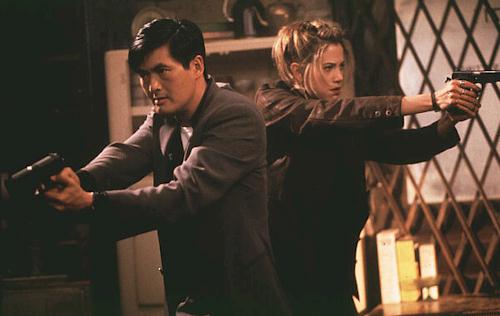
Two moments cement her appeal for me. One is visual: during the shootout in her first scene, she and Chow Yun-Fat arrive in the same room and drop into the same pose, only aiming in opposite directions. The image says it all: it's the mutual competence of equals. And in an action movie, if you're as competent as Chow Yun-Fat, you're doing all right.

The second occurs later, when John forces Meg at gunpoint to accompany him. She gives him a look that could freeze magma and says calmly, "Okay, if that's the way you want to play it. But when the gun is in my hand, we're going to have this conversation again."
There's a ton of other things that make Meg cool, but in some ways the things she doesn't do are more interesting. She never panics. She may yell, but she never once screams. She never stops trying to resolve the immediate situation. Yes, she's feminine and sexy, but it's incidental; there's only one fleeting shot I'd describe as actual Michael Bay-style pandering.
If you decide to see the film, seek out the "extended cut" DVD. Since it was made in 1998, when Hong Kong was about to revert to Chinese control, a crucial subplot was minimized in the theatrical release to avoid offending China and losing Chow Yun-Fat's hometown market. It's been restored here, and it fleshes out the motivations in a pretty substantial way.

It's obvious that we, the public, want different things from our heroines than from our heroes. It's why Supergirl dresses like a cheerleader, after all. But occasionally, amongst the pantings and leerings of the Bays and Favreaus, a real person slips through. Mira Sorvino's Meg Coburn was one of those. It's a shame more people didn't notice.
I love action heroines. I've even put one in my next Eddie LaCrosse novel, Wake of the Bloody Angel. But my standards require, if not strict adherence, at least lip service to the laws of the natural world. That negates the whole concept of the the "ass-kicking sprite," wherein a tiny female character suddenly has the ability to overpower people (usually men) three times her size. No, my idea of an action heroine is someone like Xena, who has the physical size and strength to really do battle. And of course, the gold standard is Ellen Ripley in Aliens. She has no super, or supernatural, powers; she's merely tough, resourceful, determined and smart.
Which brings me to the great forgotten action heroine: Meg Coburn. Feel free to insert your own variation of, "Who?"

Meg Coburn, played by Mira Sorvino, was the heroine of Antoine Fuqua's 1998 film The Replacement Killers. Notable as the American film debut for Hong Kong star Chow Yun-Fat, it's a fairly simple story of hired killer John Lee (Chow), who decides he has a conscience after all. Meg Coburn is a forger he hires to make a new passport so he can return to China and protect his family. Unfortunately the bad guys intervene, putting Lee and Meg on the run together.
Two moments cement her appeal for me. One is visual: during the shootout in her first scene, she and Chow Yun-Fat arrive in the same room and drop into the same pose, only aiming in opposite directions. The image says it all: it's the mutual competence of equals. And in an action movie, if you're as competent as Chow Yun-Fat, you're doing all right.
The second occurs later, when John forces Meg at gunpoint to accompany him. She gives him a look that could freeze magma and says calmly, "Okay, if that's the way you want to play it. But when the gun is in my hand, we're going to have this conversation again."
There's a ton of other things that make Meg cool, but in some ways the things she doesn't do are more interesting. She never panics. She may yell, but she never once screams. She never stops trying to resolve the immediate situation. Yes, she's feminine and sexy, but it's incidental; there's only one fleeting shot I'd describe as actual Michael Bay-style pandering.
If you decide to see the film, seek out the "extended cut" DVD. Since it was made in 1998, when Hong Kong was about to revert to Chinese control, a crucial subplot was minimized in the theatrical release to avoid offending China and losing Chow Yun-Fat's hometown market. It's been restored here, and it fleshes out the motivations in a pretty substantial way.

It's obvious that we, the public, want different things from our heroines than from our heroes. It's why Supergirl dresses like a cheerleader, after all. But occasionally, amongst the pantings and leerings of the Bays and Favreaus, a real person slips through. Mira Sorvino's Meg Coburn was one of those. It's a shame more people didn't notice.
Monday, August 22, 2011
Love, Revenge and Conan: What's My Motivation?
NOTE: THIS IS THE NEXT-TO-LAST POST FOR THIS LOCATION. AT THE END OF AUGUST, THIS BLOG WILL NO LONGER BE UPDATED. MY BLOG WILL BE FOUND AT MY NEWLY-REVAMPED WEBSITE, ALEX BLEDSOE.COM.
So there's a new Conan movie. And, if the previews are any indication, Conan spends the movie on a quest for revenge against the villain(s) who destroyed his village and murdered his family.
I won't go into how many ways this deviates from the original Robert E. Howard character (short answer: a lot). Instead, it got me thinking about screenwriters and how they think.
Consider the idea of "motivation." In movies, heroes are usually motivated by either love or revenge. And they must have a definite, solid, entirely personal reason for doing anything. I first became conscious of this trope watching The Skeleton Key, eighty percent of a great horror movie. Caroline, played by Kate Hudson, talks about how she became a geriatrics nurse after watching an elderly relative slowly die from Alzheimer's.

"Ah-HA! My motivation! Now I can act!"
Really? So she couldn't be a person who looked at possible careers and chose one that sounded good, or wanted to have a job with security, or any of the reasons most of us choose our jobs? No, there had to be a hyper-dramatic, entirely personal reason so that the audience will "sympathize" with her.
Giving Caroline such a background smacks of a "Screenwriting for Dummies" lesson. Sure, characters need motivation. But screenwriters seem unable to accept that "earning a paycheck," "providing for my family" or most crucially "the satisfaction of a job well done" are acceptable motivations. If the line "this time it's personal" doesn't apply, then it isn't valid.
Except that it is.
Here are two examples from the work of Oscar-winning director/screenwriter William Friedkin. In his 1986 film To Live and Die in L.A., FBI agent Richard Chance (CSI's William Petersen) sets out to bring down villain Rick Masters (Willem Dafoe) after Masters kills his partner. He even blatantly states, "I'm gonna bag Masters, and I don't give a shit how I do it." It's a textbook--well, a screenwriting textbook--character motivation. This time it's personal, and it encompasses both love (of the bromance kind) and revenge. It keeps an otherwise excellent movie from being truly great.

Conversely, in Friedkin's 1971 film The French Connection, New York cop Popeye Doyle (Gene Hackman) stays tenaciously on the villain's tail because, simply, it's his job. He needs no ulterior motive, nothing that says "this time it's personal." Through the course of the story it becomes personal, but only because the villain's success reflects badly on his professionalism. His ego is tied to his job, and he simply can't let the bad guys win. There's no hint that a childhood trauma caused this, or that a gangster (or Frenchman) once killed his family, or any sort of trite justification. It's realistic, and it's one of the elements that helps make the film a classic.

There are many useful things novelists can learn from screenwriters: get to the point, keep the action moving, craft witty dialogue and so forth. But this is one lesson they should skip. So make sure that you take away the right lessons, and stay grounded in reality where there are many other motivations besides love and revenge.
But....
As I read over the above, I realized my perspective is entirely one-sided. So for another point of view, I asked writer and USC film graduate Melissa Olson to comment on what I'd written so far. She responded:
"When I was at USC, nobody dreamed of being the next Michael Bay (well, maybe in the directing track(:). Everyone dreamed of telling the story they wanted to tell, to make the statement they wanted to make. But once you get out of school, the film industry is a tough business.
"Screenwriting is complicated, and in many ways it’s much more restrictive than novels. Maybe the screenwriters of Conan (there were three) didn’t want the movie to be about motivation; they wanted to get that out of the way and tell a different story. Shortcuts aren’t terrible things, they’re just easy ways out. Sometimes you gotta take one to get to where you want to go."
So there's two sides to this. What do you, the reader/filmgoer, think?
So there's a new Conan movie. And, if the previews are any indication, Conan spends the movie on a quest for revenge against the villain(s) who destroyed his village and murdered his family.
I won't go into how many ways this deviates from the original Robert E. Howard character (short answer: a lot). Instead, it got me thinking about screenwriters and how they think.
Consider the idea of "motivation." In movies, heroes are usually motivated by either love or revenge. And they must have a definite, solid, entirely personal reason for doing anything. I first became conscious of this trope watching The Skeleton Key, eighty percent of a great horror movie. Caroline, played by Kate Hudson, talks about how she became a geriatrics nurse after watching an elderly relative slowly die from Alzheimer's.

"Ah-HA! My motivation! Now I can act!"
Really? So she couldn't be a person who looked at possible careers and chose one that sounded good, or wanted to have a job with security, or any of the reasons most of us choose our jobs? No, there had to be a hyper-dramatic, entirely personal reason so that the audience will "sympathize" with her.
Giving Caroline such a background smacks of a "Screenwriting for Dummies" lesson. Sure, characters need motivation. But screenwriters seem unable to accept that "earning a paycheck," "providing for my family" or most crucially "the satisfaction of a job well done" are acceptable motivations. If the line "this time it's personal" doesn't apply, then it isn't valid.
Except that it is.
Here are two examples from the work of Oscar-winning director/screenwriter William Friedkin. In his 1986 film To Live and Die in L.A., FBI agent Richard Chance (CSI's William Petersen) sets out to bring down villain Rick Masters (Willem Dafoe) after Masters kills his partner. He even blatantly states, "I'm gonna bag Masters, and I don't give a shit how I do it." It's a textbook--well, a screenwriting textbook--character motivation. This time it's personal, and it encompasses both love (of the bromance kind) and revenge. It keeps an otherwise excellent movie from being truly great.

Conversely, in Friedkin's 1971 film The French Connection, New York cop Popeye Doyle (Gene Hackman) stays tenaciously on the villain's tail because, simply, it's his job. He needs no ulterior motive, nothing that says "this time it's personal." Through the course of the story it becomes personal, but only because the villain's success reflects badly on his professionalism. His ego is tied to his job, and he simply can't let the bad guys win. There's no hint that a childhood trauma caused this, or that a gangster (or Frenchman) once killed his family, or any sort of trite justification. It's realistic, and it's one of the elements that helps make the film a classic.

There are many useful things novelists can learn from screenwriters: get to the point, keep the action moving, craft witty dialogue and so forth. But this is one lesson they should skip. So make sure that you take away the right lessons, and stay grounded in reality where there are many other motivations besides love and revenge.
But....
As I read over the above, I realized my perspective is entirely one-sided. So for another point of view, I asked writer and USC film graduate Melissa Olson to comment on what I'd written so far. She responded:
"When I was at USC, nobody dreamed of being the next Michael Bay (well, maybe in the directing track(:). Everyone dreamed of telling the story they wanted to tell, to make the statement they wanted to make. But once you get out of school, the film industry is a tough business.
"Screenwriting is complicated, and in many ways it’s much more restrictive than novels. Maybe the screenwriters of Conan (there were three) didn’t want the movie to be about motivation; they wanted to get that out of the way and tell a different story. Shortcuts aren’t terrible things, they’re just easy ways out. Sometimes you gotta take one to get to where you want to go."
So there's two sides to this. What do you, the reader/filmgoer, think?
Thursday, August 18, 2011

Monday, August 15, 2011
Wednesday, August 10, 2011
Torchwood: For grownups, but not by them

Captain Jack Harkness, who is VERY pleased to meet you.
As part of our immersion into the universe of Doctor Who, the management staff at Chez Bledsoe has been watching the first season of Torchwood. Basically an English (well, Welsh) version of The X-Files, it's about a super-secret team who deal with otherworldly and paranormal dangers that beset contemporary Cardiff.
It doesn't take many episodes before you realize that the Torchwood team is its own worst enemy. Whatever the qualifications for joining, they seriously need to be rethought: in nine out of the ten first episodes, the primary danger is caused by a member of Torchwood (and in that tenth episode, nothing happens. Pretty much literally). The cast is interesting, the budget more than adequate, and the premise rich. So what's wrong?
Torchwood tries very hard to be cutting edge, especially in its approach to sexuality. The leader, Captain Jack Harkness, will, ahem, shag anything that moves--male, female, or other--as long as it's gorgeous. Computer whiz Tosh has a lesbian fling with an alien disguised as a human woman. Gwen and Owen, two team members, have an ongoing affair, and it's implied that uptight Ianto and Captain Jack have an occasional after-hours tryst. None of these are bad ideas, but they're also not thought through. The writers have people shagging for no apparent, logical reason except that it's titillating.
And that's when I realized what was fundamentally wrong about the show.
Torchwood feels like a fifteen-year-old's view of how adults act. Since most teenagers are obsessed with sex, so are the Torchwooders. But since most fifteen-year-olds don't have a lot of experience with sex, the relationships feel forced and phony, more like masturbatory fantasies than real encounters. Most teens have never held jobs, let alone jobs with responsibility, so they imagine worksite conflicts that simply wouldn't occur among highly-trained and supposedly elite team members. Instead of professionalism, we get playground arguments transposed to Torchwood HQ. Fights break out, but like playground fights, the next day they're forgotten--even when one team member threatens another with a gun.
I doubt that the writing staff on Torchwood is seriously fifteen years old. Instead they're likely the same kind of "talent" you see everywhere now: people raised on movies and TV who have gone into the industry at such a young age that they have no real life experiences to bring to their writing, only bits and pieces of other shows and movies. In some cases, such as the films of Quentin Tarantino, that's enough. Here it's not.
We'll probably continue watching the show, alternating it with Doctor Who. I've heard from multiple trustworthy sources that season 2 gets much better. And perhaps it does; after all, fifteen-year-olds do eventually mature, even if only a little bit.
Tuesday, August 2, 2011
Publishers Weekly reviews THE HUM AND THE SHIVER
In its review, Publishers Weekly calls my upcoming novel The Hum and the Shiver a "masterpiece of world-building." Hell, I'll take that.
Monday, August 1, 2011
Genre respect and the NYT
It's an ongoing issue that genre fiction--mystery, science fiction, fantasy, romance, horror--is somehow less important than so-called "literary" fiction. That involves forgetting that in many cases the disposable genre fiction of yesterday (Jules Verne, HG Wells, Edgar Allen Poe, HP Lovecraft, Louis L'Amour, Jack London, Dashiell Hammett, Raymond Chandler) has become the acknowledged classics of today.
Still, it's frustrating to still see this play out right in front of me, as it did last month in the New York Times. I won't use the authors' names here, because it's not important; it's not hard to figure out if you feel the need, but it's utterly beside the point. To me, what's important is how this "corps of impudent snobs who characterize themselves as intellectuals" (props to Spiro Agnew) pronounces and supports its judgment.
Here are two excerpts from the literary novel's review:
"So does the new novel deliver? I’m not so sure...the author seems a bit lost, adrift in unfamiliar waters, and the book feels less like a second novel than it does another try at a first."
"There is only so much we can read this way before we are overwhelmed by the desire to drop the pretense."
And here are two from the review of the genre novel:
"[The author's] novel has the stylized quality of books by Angela Carter like The Infernal Desire Machines of Doctor Hoffman, and it displays similar pyrotechnics."
"Yet in a highwire act of her own, [the author] still raises the novel above the ordinary through her ability to convey the richness of the [characters’] emotional lives, coupled with impressive writing."
Clearly the first review was less than positive, while the second was close to a rave. Now, the kicker: which book got the three-page excerpt also published in the New York Times? That's right, after their reviewer says "There is only so much we can read this way before we are overwhelmed by the desire to drop the pretense," the Times decides to put that to the test.
As I said, I mean no disrespect to either writer. I do mean disrespect to this constant shafting of the genre in which I work, in which a lot of people do great work that readers actually want to read. How do I know? You don't get David Foster Wallace conventions; you do get Terry Pratchett ones.
But perversely I also enjoy this lack of respect. Like Superman and Lex Luthor, or Batman and the Joker, your hero is measured against the strength and cunning of the villain opposing him/her. And when you get right down to it, the Literary Establishment is actually a lot like Lex Luthor: powerful, entrenched, sophisticated, and--most delightfully--fundamentally threatened by those aliens in their brightly colored costumes.
Now if you'll excuse me, I have to go put on my cape and long underwear.
Still, it's frustrating to still see this play out right in front of me, as it did last month in the New York Times. I won't use the authors' names here, because it's not important; it's not hard to figure out if you feel the need, but it's utterly beside the point. To me, what's important is how this "corps of impudent snobs who characterize themselves as intellectuals" (props to Spiro Agnew) pronounces and supports its judgment.
Here are two excerpts from the literary novel's review:
"So does the new novel deliver? I’m not so sure...the author seems a bit lost, adrift in unfamiliar waters, and the book feels less like a second novel than it does another try at a first."
"There is only so much we can read this way before we are overwhelmed by the desire to drop the pretense."
And here are two from the review of the genre novel:
"[The author's] novel has the stylized quality of books by Angela Carter like The Infernal Desire Machines of Doctor Hoffman, and it displays similar pyrotechnics."
"Yet in a highwire act of her own, [the author] still raises the novel above the ordinary through her ability to convey the richness of the [characters’] emotional lives, coupled with impressive writing."
Clearly the first review was less than positive, while the second was close to a rave. Now, the kicker: which book got the three-page excerpt also published in the New York Times? That's right, after their reviewer says "There is only so much we can read this way before we are overwhelmed by the desire to drop the pretense," the Times decides to put that to the test.
As I said, I mean no disrespect to either writer. I do mean disrespect to this constant shafting of the genre in which I work, in which a lot of people do great work that readers actually want to read. How do I know? You don't get David Foster Wallace conventions; you do get Terry Pratchett ones.
But perversely I also enjoy this lack of respect. Like Superman and Lex Luthor, or Batman and the Joker, your hero is measured against the strength and cunning of the villain opposing him/her. And when you get right down to it, the Literary Establishment is actually a lot like Lex Luthor: powerful, entrenched, sophisticated, and--most delightfully--fundamentally threatened by those aliens in their brightly colored costumes.
Now if you'll excuse me, I have to go put on my cape and long underwear.
Sunday, July 31, 2011
My favorite science fiction joke
I'm guest blogging at The Night Bazaar about my favorite science fiction joke.
Monday, July 25, 2011
Age ain't nothin' but a...problem
In a recent Wall Street Journal, Alexandra Alter talked about the dangers of having your literary characters, especially detectives, age in real time. She cites several examples of authors allowing their characters to develop the infirmities and declines that come with advancing years, as well as those who freeze their heroes in time so that while the world changes, they don't.
The original detective heroes like the Continental Op and Philip Marlowe didn't face this worry. Their series were relatively short compared to what we now consider a successful run: seven novels and some short stories for Marlowe, compared to 21 for John Sandford's "Prey" series; Agatha Christie's Miss Marple racked up 12 novels, against 40 for Robert B. Parker's Spenser. Sam Spade, the quintessential tough-guy detective, exists in only a single novel, The Maltese Falcon.
The appetite for series now requires at least a book a year, and authors with contemporary settings have to face the fact that the world changes around their heroes. Do the heroes change with it? Some do. James Lee Burke's Dave Robicheaux, once young enough to be played in a movie by Alec Baldwin, is now 73. Michael Connelly's 60-year-old Harry Bosch has to deal with the vagaries of contemporary retirement. But some, like Spenser or Kay Scarpetta, don't. In fact, the biggest surprise in the article was how many authors began with their heroes aging, and then arbitrarily froze them in time when the series became successful.
It made me think about Eddie LaCrosse's age, and how that affects his ongoing adventures. I created his prototype character when I was 18, but I wanted him to be worldly and sophisticated, so I made him roughly 35, which is his age in The Sword-Edged Blonde. At the time I thought that was mature enough to give him the perspective I wanted. However, by the time the book actually came out I was over 40, which meant I was now writing about a character a decade younger than me. Further, and strange as it seems, I'm continuing to age. So I'm faced with the dilemma of what age Eddie should be in each book.
Luckily I'm freed from the worries of the modern world, since Eddie's world is fantasy and only changes when I change it. But I still want him to be believable, and part of that is aging. I don't have a set time frame, like Stephanie Plum (Kinsey Millhone ages one year for every 2 1/2 books, so she'll be about 40 when the series concludes). But he does progress. In the framing story of Dark Jenny I think he's about thirty-eight, settled into his relationship with Liz and established in Neceda. In the next book, Wake of the Bloody Angel, he's about the same age. Which works out to real-time again, one year per book, by default. But it's not deliberate, therefore I can't be held to it. Ultimately, Eddie's as old as I say he is.
The original detective heroes like the Continental Op and Philip Marlowe didn't face this worry. Their series were relatively short compared to what we now consider a successful run: seven novels and some short stories for Marlowe, compared to 21 for John Sandford's "Prey" series; Agatha Christie's Miss Marple racked up 12 novels, against 40 for Robert B. Parker's Spenser. Sam Spade, the quintessential tough-guy detective, exists in only a single novel, The Maltese Falcon.
The appetite for series now requires at least a book a year, and authors with contemporary settings have to face the fact that the world changes around their heroes. Do the heroes change with it? Some do. James Lee Burke's Dave Robicheaux, once young enough to be played in a movie by Alec Baldwin, is now 73. Michael Connelly's 60-year-old Harry Bosch has to deal with the vagaries of contemporary retirement. But some, like Spenser or Kay Scarpetta, don't. In fact, the biggest surprise in the article was how many authors began with their heroes aging, and then arbitrarily froze them in time when the series became successful.
It made me think about Eddie LaCrosse's age, and how that affects his ongoing adventures. I created his prototype character when I was 18, but I wanted him to be worldly and sophisticated, so I made him roughly 35, which is his age in The Sword-Edged Blonde. At the time I thought that was mature enough to give him the perspective I wanted. However, by the time the book actually came out I was over 40, which meant I was now writing about a character a decade younger than me. Further, and strange as it seems, I'm continuing to age. So I'm faced with the dilemma of what age Eddie should be in each book.
Luckily I'm freed from the worries of the modern world, since Eddie's world is fantasy and only changes when I change it. But I still want him to be believable, and part of that is aging. I don't have a set time frame, like Stephanie Plum (Kinsey Millhone ages one year for every 2 1/2 books, so she'll be about 40 when the series concludes). But he does progress. In the framing story of Dark Jenny I think he's about thirty-eight, settled into his relationship with Liz and established in Neceda. In the next book, Wake of the Bloody Angel, he's about the same age. Which works out to real-time again, one year per book, by default. But it's not deliberate, therefore I can't be held to it. Ultimately, Eddie's as old as I say he is.
Wednesday, July 20, 2011
A free market of idiots
I'm enough of an ex-journalist that I've read with interest about Britain's scandal-plagued scandal sheet News of the World. Short version: to feed its tabloid readership, the paper hacked into the e-mails, phones and private records of politicians and celebrities, to great financial success. So far so good, but then they broke into the voice mail of a murdered teenage girl, even deleting some of her messages so that her parents believed (falsely) that she was alive. That was the line, and they crossed it.
This has been roundly condemned, as it should be, and it's brought a lot of attention to the nature of British media, also as it should be. Those on the left are trying mightily to attach the scandal to Rupert Murdoch, head of News Corp and owner of News of the World (and of course Fox News here in the US). He's, of course, denying any knowledge of these actions.
But I don't think Murdoch is utlimately to blame. I think the blame lies here:

Let me be clear: it's not the magazines. It's the person buying them.
Murdoch and his kind do nothing more than obey the first rule of business: give the people what they want. From gossip to innuendo to outright lies, his various media outlets have one thing in common: success. If nobody cared about celebrities, he wouldn't be in the gossip business. If people turned off news that was repeatedly shown to be biased, and with occasional outright fabrications, his news shows would either straighten up or go dark. And if there wasn't a ravenous appetite for sordid details, the phone of a dead girl would not have been hacked.

Every person who buys a magazine with a Kardashian on the cover, or watches the Octomom on TV, or reads Perez Hilton online is as responsible, if not more so, than Rupert Murdoch for the state of media and so-called "news." These consumers have created the environment that promises economic rewards for hacking the phone of a dead girl. The defense is that these magazines are "harmless," that celebrity gossip is "just for fun," but now we've learned that "fun" might extend to the private e-mails, voice mails and medical records of 9/11 families (the FBI is investigating that). Is that "harmless?" Because once you've exhausted celebrity culture (and please, God, I hope we're close), the only things left are private citizens with the bad luck to suffer public tragedy. And that could be any of us. Our worst nightmare could be marketed as "just for fun."
So, let me be plain: supporting this crap with your money and time makes you the problem, not the people who produce it. Stop buying it, and they'll go away. That's how an intelligent free market works. But a free market of idiots leads to this:

This has been roundly condemned, as it should be, and it's brought a lot of attention to the nature of British media, also as it should be. Those on the left are trying mightily to attach the scandal to Rupert Murdoch, head of News Corp and owner of News of the World (and of course Fox News here in the US). He's, of course, denying any knowledge of these actions.
But I don't think Murdoch is utlimately to blame. I think the blame lies here:

Let me be clear: it's not the magazines. It's the person buying them.
Murdoch and his kind do nothing more than obey the first rule of business: give the people what they want. From gossip to innuendo to outright lies, his various media outlets have one thing in common: success. If nobody cared about celebrities, he wouldn't be in the gossip business. If people turned off news that was repeatedly shown to be biased, and with occasional outright fabrications, his news shows would either straighten up or go dark. And if there wasn't a ravenous appetite for sordid details, the phone of a dead girl would not have been hacked.

Every person who buys a magazine with a Kardashian on the cover, or watches the Octomom on TV, or reads Perez Hilton online is as responsible, if not more so, than Rupert Murdoch for the state of media and so-called "news." These consumers have created the environment that promises economic rewards for hacking the phone of a dead girl. The defense is that these magazines are "harmless," that celebrity gossip is "just for fun," but now we've learned that "fun" might extend to the private e-mails, voice mails and medical records of 9/11 families (the FBI is investigating that). Is that "harmless?" Because once you've exhausted celebrity culture (and please, God, I hope we're close), the only things left are private citizens with the bad luck to suffer public tragedy. And that could be any of us. Our worst nightmare could be marketed as "just for fun."
So, let me be plain: supporting this crap with your money and time makes you the problem, not the people who produce it. Stop buying it, and they'll go away. That's how an intelligent free market works. But a free market of idiots leads to this:

Monday, July 18, 2011
Review: the anti-western Doc
I love movies about the 1881 showdown in Tombstone, AZ between Wyatt Earp and the Clanton gang. My favorite is Tombstone, but I won't sleight Gunfight at the OK Corral, My Darling Clementine, or Hour of the Gun (which actually starts with the gunfight and follows the events afterward). I can't stand Kevin Costner's epic, sprawling Wyatt Earp, which demythologizes the central character to the point that you actually wonder why anyone would make a movie about him, yet still holds him up as a hero.
But it ain't nothing compared to the demythologizing in Frank Perry's 1971 film, Doc. Even the poster brags about the tear-down:

Stacy Keach plays Doc Holliday, former dentist and current tubercular gambler, drifting across Arizona to join his friend Earp in Tombstone. Earp is played by Harris Yulin, a ubiquitous character actor who you'll instantly recognize even if the name doesn't register (he even played a Cardassian in Deep Space Nine). Also co-starring is Faye Dunaway as Kate Elder, aka "Big Nose" Kate, Doc's mistress.
With Doc as the central character, we're given the legend from the side. Earp may be the marshall, but he recognizes that in Tombstone, it's the sheriff who runs things. He runs for that office, and makes a deal with the Clanton gang to turn over one of their own at the appropriate time to secure Earp's victory. This view of Earp as not just a brutal man but a corrupt one leaves Costner's arrogant misanthrope in the dust. Doc is Earp's friend, but when he realizes what Earp's done he's caught in a quandary. How that resolves is one of the most cynical depictions of human nature I've seen; it makes Glengarry Glen Ross look like Amelie.

Stacy Keach and Faye Dunaway.
But unlike the Costner film, which seems to think Earp is still deserving of heroic status even after he's shown to be pretty much a total prick, Doc earns its cynicism. Doc is a flawed man who sees himself honestly, and allows himself a brief respite of thinking his life might be salvageable despite his tuberculosis. When he realizes it isn't, he goes with the flow and accepts his fate. The story takes place in a Western world that goes Sergio Leone one better: everyone is dirty and dusty, and at times you can almost smell their unwashed bodies. And the music, by songwriter Jimmy Webb ("MacArthur Park") is low-key and based in period sounds; there's no Elmer Bernstein flourish here.

Harris Yulin as Wyatt Earp.
Doc isn't a feel-good Western, for sure, nor a flawless one: many scenes seem cut too early, as if they needed another few moments to play out. But Keach's performance is so open and minimal that it draws you in, and Yulin's take on Earp never fails to surprise. If you're a fan of Westerns, or just of familiar tales told in new ways, I highly recommend it.
But it ain't nothing compared to the demythologizing in Frank Perry's 1971 film, Doc. Even the poster brags about the tear-down:

Stacy Keach plays Doc Holliday, former dentist and current tubercular gambler, drifting across Arizona to join his friend Earp in Tombstone. Earp is played by Harris Yulin, a ubiquitous character actor who you'll instantly recognize even if the name doesn't register (he even played a Cardassian in Deep Space Nine). Also co-starring is Faye Dunaway as Kate Elder, aka "Big Nose" Kate, Doc's mistress.
With Doc as the central character, we're given the legend from the side. Earp may be the marshall, but he recognizes that in Tombstone, it's the sheriff who runs things. He runs for that office, and makes a deal with the Clanton gang to turn over one of their own at the appropriate time to secure Earp's victory. This view of Earp as not just a brutal man but a corrupt one leaves Costner's arrogant misanthrope in the dust. Doc is Earp's friend, but when he realizes what Earp's done he's caught in a quandary. How that resolves is one of the most cynical depictions of human nature I've seen; it makes Glengarry Glen Ross look like Amelie.

Stacy Keach and Faye Dunaway.
But unlike the Costner film, which seems to think Earp is still deserving of heroic status even after he's shown to be pretty much a total prick, Doc earns its cynicism. Doc is a flawed man who sees himself honestly, and allows himself a brief respite of thinking his life might be salvageable despite his tuberculosis. When he realizes it isn't, he goes with the flow and accepts his fate. The story takes place in a Western world that goes Sergio Leone one better: everyone is dirty and dusty, and at times you can almost smell their unwashed bodies. And the music, by songwriter Jimmy Webb ("MacArthur Park") is low-key and based in period sounds; there's no Elmer Bernstein flourish here.

Harris Yulin as Wyatt Earp.
Doc isn't a feel-good Western, for sure, nor a flawless one: many scenes seem cut too early, as if they needed another few moments to play out. But Keach's performance is so open and minimal that it draws you in, and Yulin's take on Earp never fails to surprise. If you're a fan of Westerns, or just of familiar tales told in new ways, I highly recommend it.
Wednesday, July 13, 2011
Interview: Genevieve Valentine, author of Mechanique

Recently I reviewed the debut novel by Genevieve Valentine, Mechanique: A Tale of the Circus Tresaulti. I thought it a brilliant and intriguing book, and as a writer, I wondered about the thought process behind some of the concepts. Genevieve was kind enough to answer some questions for me.
The bones (in the story, circus aerialists have their human bones replaces with light, hollow copper one) represent different things to each character who receives them. What inspired them, and what did they represent for you, the author?
Appropriately enough, bird skeletons were a large part of the influence on the bones. I was looking them up for something unrelated, but the physiology was really interesting and stuck with me as I started writing about what exactly made the performers in the Circus Tresaulti so different. For me, the bones were always a tangible symbol of the sacrifices you make for something you love, though the self-destructive aspect of it often goes hand-in-hand, depending on the character.
The narrative jumps among several voices and points of view. Why did you choose that form?
When I sat down to begin I just started writing, and the scenes I wanted to get down first came first, in the perspective I thought made the most sense. By the time I had the breathing space to sit back and worry if it was going to work, I loved how it was coming together too much to think about stopping.
The story doesn't have a specific setting, either geographically or in time. Why did you decide on that?
I approached it with the idea that the deep aftermath of a war takes on this air of inevitability and surreality, as if it both defined and took place outside of the world now. With a war as big as the one that's implied here, that devastates natural resources and completely shifts the practice of government, old nations and eras slowly cease to matter. It doesn't help that the Circus operates in this landscape as they themselves are a bit unstuck in time by the magic that holds the Circus together.
How well did the artwork by Kiri Moth capture your sense of the story?
SO WELL. Sorry for the caps, but it's awesome. The cover alone is so detailed and evocative that no one could ask for more, but for me, some of the interior art pieces truly hit home. My two favorites are probably the griffin, which is so perfect it's become an emblem for the Circus in earnest, and Elena on the trapeze. The grace and introspection and loneliness of that moment is exactly how I had pictured it when I was writing, and seeing the recreation in my inbox the first time, I clutched my pearls like a dowager.
Thanks to Genevieve for answering my questions. You can find Mechanique: A Tale of the Circus Tresaulti at all the usual outlets.
Monday, July 11, 2011
Review: Mechanique by Genevieve Valentine

Bruce Springsteen says his classic song "Born to Run" is about people looking for "connection." The great crime novelist Andrew Vachss fills his stories with people forming "families of choice" to retain their humanity against the brutal outside world. And in the same vein, the heart of Genevieve Valentine's Mechanique: A Tale of the Circus Tresaulti shows how the bonds of family can form between and among people who otherwise have nothing in common.
If you have to give it a genre, I suppose Mechanique counts as steampunk. Or fantasy. Some aspects verge on science fiction. But it plays with these conventions as much as it does with narrative form. It's not set in the past, like steampunk, and it's not about technology, like science fiction. Its landscape is post-apocalyptic, but with no set time frame (or even confirmation that it's actually set on Earth). And there is a sense of magic to what happens, but it's so grounded, so organic and mundane, that it's as far from the standard tropes as you can get. None of this really matters, though, because ultimately it's about people-building, not world-building.
Via a fractured narrative point of view, we learn that the circus, led by the enigmatic woman known only as Boss, features performers that are part metal, with hollow copper bones to make their feats that much more astounding. One even features the enormous metal wings shown on the cover, but he's dead when the story begins. Which doesn't mean he doesn't figure in things, because Valentine jumps back and forth, changing point of view and time frame whenever it suits her. The story is most often told by Little George, a boy of indeterminate age who works as Boss' go-fer. Through him we learn the complexities of the Tresaulti personalities, and a bit about how some of them came to join the circus. It's a real tribute to Valentine's skill that this is never confusing or disorienting.
If there's a criticism to be made, it's that the plot takes so long to get going, it almost seems like an intrusion. For its first half Mechanique is a brilliant high wire act of a mood piece; the events of the second half jar only because of their relative normality. But that's minor, and ultimately the second half wouldn't work without the emotional investment of the first.
I've known Genevieve for several years now, mostly as a delightful raconteur at conventions and a deliciously snarky columnist. I'd read some of her short fiction, but nothing prepared me for this, not even hearing her read the first few chapters at last year's World Fantasy Convention. She's created a unique world here, and made a brilliant debut as a novelist.
Come back Wednesday for an interview with Genevieve Valentine.
Sunday, July 10, 2011
Guest blogging on why I'm no longer a Star Wars fan

At the Borders SciFi blog, I talk about why I'm no longer a fan of Star Wars. It has nothing to do with who shot first. Read about it here.
Wednesday, July 6, 2011
Guest blogging on the (re)claiming of Lois Lane
I'm guest blogging at SF Signal about Lois Lane, and how she changed between the original cut of Superman II and the 2006 restored "Donner Cut." Stop by and leave a comment!


Monday, July 4, 2011
Look back in chagrin
Recently I've been revising an old manuscript that I originally wrote over a decade ago, and haven't touched in at least seven years. It's an interesting window into the past of my own creative process, and some lessons I've since learned are vividly displayed in all their teeth-gnashing glory. Here are some examples.
1) A little description goes a long way. I described the physical settings in great detail, thinking at the time that the action wouldn't work without it. I try to always make my action scenes use the specific geography I've set up, so that the reader gets the sense that these events could happen nowhere else. I now know that back then, I seriously underestimated the reader's ability to comprehend. For example, I had this as a description of a creek:
"The creek occupied an open ribbon of ground fifty feet wide, and the grass beyond it grew high enough to hide anything."
I thought that readers needed to know that the width of open ground would accommodate the events about to occur. However, in revision I realized this was didactic overkill. Whatever image of a "creek" the reader conjures will work quite well, and has the virtue of getting the reader to contribute to the story's reality.
I also tended to give exact measurements when they weren't necessary. For example, "[it] landed hard on its belly ten yards away." In context of the scene, knowing the precise distance is pedantic and unnecessary.
2) There's a fine line between ambiguity and confusing lack of information, and I often have trouble seeing this line until someone points it out to me. In this story, the plot was set in motion by a man wandering out of the desert and promptly dropping dead. We never found out who he was, where he came from, or why he carried the McGuffin he brought. In re-reading I realized this was a huge dangling plot point that might--and probably should--annoy the reader. So while I liked the ambiguity and wanted to keep as much as possible, I filled in some more detail and implication, so there's at least some sort of explanation.
3) Elmore Leonard, a man who should know, advises, "Never use a verb other than 'said' to carry dialogue." I had clearly not grasped that concept. If the tone of the dialogue isn't clear from the dialogue itself, then in most cases you need to back up and rethink the words. Certainly I did.
4) My chapters have gotten shorter. The first five chapters of this book averaged 17-18 manuscript pages, while my more recent ones are between 13-15. This is an observation, not a value judgment, since in one sense a chapter is as long as it needs to be. But evidently mine need to be shorter than they used to.
And finally,
5) The chapters may be longer, but this book was short. Really short. 350 manuscript pages, when my average for the Eddie LaCrosse series is between 400-420 (and even that's short compared to most fantasy novels). As I revise, I've found places to legitimately add more detail and incident, but I internalized too much journalism to tolerate any padding. And that's another important lesson: like a chapter, a story is as long as it is. Some stories might need multiple volumes of a thousand pages each; then again, some might just take 400 or so pages. Maybe less.
Yes, a lot of these lessons caused me to wince, clench my teeth and look away in both disgust and horror. The urge to think, "I can't believe I wrote something so bad" is pretty strong. But it's also incorrect. I wrote this story the best that I could at the time. I improve with each story I write, with each comment and suggestion I get from my editor, and with each book I read. The process doesn't end. So if you're an aspiring writer out there, and you resurrect an old manuscript that makes you want to give up writing forever, remember two things: a) it was the best you could do at the time, and b) you're better now.
And that should always be true.
1) A little description goes a long way. I described the physical settings in great detail, thinking at the time that the action wouldn't work without it. I try to always make my action scenes use the specific geography I've set up, so that the reader gets the sense that these events could happen nowhere else. I now know that back then, I seriously underestimated the reader's ability to comprehend. For example, I had this as a description of a creek:
"The creek occupied an open ribbon of ground fifty feet wide, and the grass beyond it grew high enough to hide anything."
I thought that readers needed to know that the width of open ground would accommodate the events about to occur. However, in revision I realized this was didactic overkill. Whatever image of a "creek" the reader conjures will work quite well, and has the virtue of getting the reader to contribute to the story's reality.
I also tended to give exact measurements when they weren't necessary. For example, "[it] landed hard on its belly ten yards away." In context of the scene, knowing the precise distance is pedantic and unnecessary.
2) There's a fine line between ambiguity and confusing lack of information, and I often have trouble seeing this line until someone points it out to me. In this story, the plot was set in motion by a man wandering out of the desert and promptly dropping dead. We never found out who he was, where he came from, or why he carried the McGuffin he brought. In re-reading I realized this was a huge dangling plot point that might--and probably should--annoy the reader. So while I liked the ambiguity and wanted to keep as much as possible, I filled in some more detail and implication, so there's at least some sort of explanation.
3) Elmore Leonard, a man who should know, advises, "Never use a verb other than 'said' to carry dialogue." I had clearly not grasped that concept. If the tone of the dialogue isn't clear from the dialogue itself, then in most cases you need to back up and rethink the words. Certainly I did.
4) My chapters have gotten shorter. The first five chapters of this book averaged 17-18 manuscript pages, while my more recent ones are between 13-15. This is an observation, not a value judgment, since in one sense a chapter is as long as it needs to be. But evidently mine need to be shorter than they used to.
And finally,
5) The chapters may be longer, but this book was short. Really short. 350 manuscript pages, when my average for the Eddie LaCrosse series is between 400-420 (and even that's short compared to most fantasy novels). As I revise, I've found places to legitimately add more detail and incident, but I internalized too much journalism to tolerate any padding. And that's another important lesson: like a chapter, a story is as long as it is. Some stories might need multiple volumes of a thousand pages each; then again, some might just take 400 or so pages. Maybe less.
Yes, a lot of these lessons caused me to wince, clench my teeth and look away in both disgust and horror. The urge to think, "I can't believe I wrote something so bad" is pretty strong. But it's also incorrect. I wrote this story the best that I could at the time. I improve with each story I write, with each comment and suggestion I get from my editor, and with each book I read. The process doesn't end. So if you're an aspiring writer out there, and you resurrect an old manuscript that makes you want to give up writing forever, remember two things: a) it was the best you could do at the time, and b) you're better now.
And that should always be true.
Wednesday, June 29, 2011
Interview with Teresa Frohock, author of Miserere
Teresa Frohock is both a friend and the author of Miserere: an Autumn Tale, a book I enjoyed so much that I gave her the following blurb:
"Miserere is about redemption, and the triumph of our best impulses over our worst. It's also about swords, monsters, chases, ghosts, magic, court intrigues and battles to the death. It's also (and this is the important part) really, really good."
You can read my full review here.

Teresa graciously agreed to answer some questions for me about the book.
You and I have both recently written books that include people of genuine, true religious faith (my book is The Hum and the Shiver, out this fall). The pitfalls of this are enormous: the danger of sanctimoniousness, of preachiness (literal and figurative), of simply alienating readers who don't share whatever faith the characters embody. How much did you worry about this, and how did you overcome it?
Thanks so much for having me here, Alex, I really appreciate the opportunity to talk about some of this.
Truth be told, I’m still worried about some of those things. Although I think people who read speculative fiction are open-minded and much more amenable to experimentation than other genres, I still worry that some may suffer contempt prior to investigation. I hope not.
It helps that I have no agenda here. I’m not out to push a viewpoint, Christian or otherwise. I just wanted to tell a story, and as I constructed Woerld, I realized the focus would be on Lucian, who happened to belong to the Christian bastion. From that point forward, I had to educate myself about Christianity and I was really surprised by the facts I found.
The version of Christianity that I present on Woerld is gleaned not just from Biblical sources, but also from the Pseudepigrapha and Apocrypa. I wanted to see what Christianity might have been like before the Schism of 1054 when Rome split from the Byzantine Church. I approached all the religions on Woerld strictly from a scholarly angle at first, then I eased the spiritual elements inherent to the practices of the religion into the story.
I focused entirely on the growth of the individual character and not the dogma of the religion. And that was hard, showing how the adherents struggle with their faith from personal viewpoints. When we speak of Muslims, Jews, Christians, Buddhists, Hindus, we tend to think in terms of groups, not individuals. I wanted to put the focus on the individual and show that
personal growth doesn’t come from automatically joining a group, but comes through the internal work of the individual.
If you read most religious texts closely, they emphasize a personal contact with a higher power, not group-think. So I did very much what you’ve done with Reverend Craig in The Hum and the Shiver—I simply had Lucian live his life in accordance with the dictates of his beliefs. I’ve always loved Emerson and Thoreau’s writings and their emphasis on the individual’s responsibility to contact the divine within and bring that light into the world through action. That is a concept inherent to all religions and I wanted to illustrate that philosophy in Miserere.
You incorporate a young woman, Lindsay, who must learn both to be a warrior (a common fantasy trope) and to truly believe in God (not so common). What did she represent for you?
Lindsay represents our twenty-first century’s society secular thinking about religion, our preconceptions and our misconceptions. Her exposure to religion comes primarily through the media, meaning she understands the various religions through the extremes of the worst possible examples of the adherents: politicians who mouth their version of Christianity while they actively engage in immoral behavior; a Catholic Church hiding child-molesting priests; jihadists that believe their way to paradise is paved with the bodies they leave behind; Hindus and Muslims and Christians and Jews constantly fighting one another either in rhetoric or with guns.
This is what Lindsay is exposed to day after day, then she is taken to the obligatory church service, plunked in a pew, and told God is love. Needless to say, she’s a tad cynical over the whole thing. Kind of like the rest of us.
So I like having her as the voice of the reader, to question Lucian and the adults in Woerld about how things work. That way I can gently ease my readers into Woerld yet not make the picture too rosy. It’s not. There are serious conflicts among the bastions and the governments in Woerld—it was never my intent to present a Utopian society.
Children aren’t afraid to question the status quo, and they see things very clearly, more clearly than adults want to admit. Lindsay is the perfect lens to view Woerld and its imperfections.
Your novel is definitely a fantasy, and many fantasies create their own religions. You chose to use actual existing world religions. What was your thought process behind that?
I thought about Tolkien and Lewis and wondered what The Lord of the Rings would have looked like if Tolkien had written it as a Catholic story instead of embedding the religious tenets beneath Middle Earth’s mythology, or what Narnia would have looked like if, instead of a lion, Aslan was the Christ. Not being as much of a fan of Tolkien as I am of Lewis, I really started reading Lewis’ works; he had a talent for rooting out the spirituality of Christianity and getting to the essence of its beliefs without sanctimony.
I checked out some other current fantasy titles that used fallen angels, and while they addressed the fallen part of the situation, very few showed it from a Christian angle. I think God’s Demon by Wayne Barlowe was the closest novel to presenting hell from a Christian viewpoint, and I love what Barlowe did with that story. The language he used, the characterization, and his perception of hell as an actual, physical place just knocked me for a loop.
Barlowe took the war in heaven and showed how the fallen angels fought. I’ve always been fascinated by the war in heaven and often wondered: what if it’s still going on? I’m sacrilegious like that.
In the end, I fell in love with the absolute challenge of it. This is my own ego talking now, but I wanted to prove you could write a fantasy with Christians in it without the story becoming insipid or preachy. I began constructing Woerld and realized that all religions have some form of hell or purgatory, so realistically, it wouldn’t be just Christians. I mean why would heaven only use a fraction of its forces to combat evil?
So the other religions started seeping in and with that there must be a hierarchy, and the structure of Woerld evolved until it became what it is in Miserere. The more I worked on it, the more detail seeped in, and again, I just loved the challenge of using real religions.
You have a male hero torn between and among a group of women: his sister, his former lover, and his new protégé. Was there a deliberate thought process behind the gender roles for these characters?
I wanted to step outside of a few of the standard fantasy tropes and twist them. The most common trope from the fairy tales of my youth was that of the beautiful princess who was captured by the evil warlord or witch and rescued by a handsome prince. I wanted to turn that trope upside down and show the handsome prince who was captured by the wicked queen and rescued by the beautiful princess. Only in Miserere, the prince takes a real beating from the wicked queen, the beautiful princess is mauled and half-mad, and the wicked queen isn’t strung too tight either.
That was my primary thinking, then everything sort of got away from me. Most people are conditioned to see men in one of two roles: protector or aggressor. Lucian sees himself as the protector, even though it is Lindsay and Rachael who end up saving him more often than he saves them. He is determined not to abandon them, though, and that’s important, that desire to be a part of someone’s life even if it means constraints on his existence.
Nor did I want the women to be perfect. Rachael had her part in her own downfall; Catarina is a grand case of self-will run riot; and Lindsay thinks they’re all being horribly unfair to Lucian while she downplays his crimes in her own mind.
When I got the cover art for Miserere (by the wonderful Michael C. Hayes), I just cried, it was better than anything I could have imagined. I had been dreading what an artist’s conception of Miserere would be, but more than anything, I feared chain mail bikinis on the women and Lucian standing with Catarina and Rachael kneeling or the women pictured lower in the foreground.

Instead, Michael got exactly what I was doing and busted the tropes with me: they’re all standing with their backs to one another; Rachael and Catarina are wearing the armor they would probably choose; Lucian is on his knees between them; and the walls of the Citadel rise behind them. Catarina’s face is cunning, Rachael is distrustfully looking at Lucian, and Lucian—my
poor Lucian—looks to Heaven, because when you’re trapped between those two women, your only salvation is from above.
Thanks to Teresa Frohock for answering my questions. Miserere: an Autumn Tale is available now from Night Shade Books.
"Miserere is about redemption, and the triumph of our best impulses over our worst. It's also about swords, monsters, chases, ghosts, magic, court intrigues and battles to the death. It's also (and this is the important part) really, really good."
You can read my full review here.

Teresa graciously agreed to answer some questions for me about the book.
You and I have both recently written books that include people of genuine, true religious faith (my book is The Hum and the Shiver, out this fall). The pitfalls of this are enormous: the danger of sanctimoniousness, of preachiness (literal and figurative), of simply alienating readers who don't share whatever faith the characters embody. How much did you worry about this, and how did you overcome it?
Thanks so much for having me here, Alex, I really appreciate the opportunity to talk about some of this.
Truth be told, I’m still worried about some of those things. Although I think people who read speculative fiction are open-minded and much more amenable to experimentation than other genres, I still worry that some may suffer contempt prior to investigation. I hope not.
It helps that I have no agenda here. I’m not out to push a viewpoint, Christian or otherwise. I just wanted to tell a story, and as I constructed Woerld, I realized the focus would be on Lucian, who happened to belong to the Christian bastion. From that point forward, I had to educate myself about Christianity and I was really surprised by the facts I found.
The version of Christianity that I present on Woerld is gleaned not just from Biblical sources, but also from the Pseudepigrapha and Apocrypa. I wanted to see what Christianity might have been like before the Schism of 1054 when Rome split from the Byzantine Church. I approached all the religions on Woerld strictly from a scholarly angle at first, then I eased the spiritual elements inherent to the practices of the religion into the story.
I focused entirely on the growth of the individual character and not the dogma of the religion. And that was hard, showing how the adherents struggle with their faith from personal viewpoints. When we speak of Muslims, Jews, Christians, Buddhists, Hindus, we tend to think in terms of groups, not individuals. I wanted to put the focus on the individual and show that
personal growth doesn’t come from automatically joining a group, but comes through the internal work of the individual.
If you read most religious texts closely, they emphasize a personal contact with a higher power, not group-think. So I did very much what you’ve done with Reverend Craig in The Hum and the Shiver—I simply had Lucian live his life in accordance with the dictates of his beliefs. I’ve always loved Emerson and Thoreau’s writings and their emphasis on the individual’s responsibility to contact the divine within and bring that light into the world through action. That is a concept inherent to all religions and I wanted to illustrate that philosophy in Miserere.
You incorporate a young woman, Lindsay, who must learn both to be a warrior (a common fantasy trope) and to truly believe in God (not so common). What did she represent for you?
Lindsay represents our twenty-first century’s society secular thinking about religion, our preconceptions and our misconceptions. Her exposure to religion comes primarily through the media, meaning she understands the various religions through the extremes of the worst possible examples of the adherents: politicians who mouth their version of Christianity while they actively engage in immoral behavior; a Catholic Church hiding child-molesting priests; jihadists that believe their way to paradise is paved with the bodies they leave behind; Hindus and Muslims and Christians and Jews constantly fighting one another either in rhetoric or with guns.
This is what Lindsay is exposed to day after day, then she is taken to the obligatory church service, plunked in a pew, and told God is love. Needless to say, she’s a tad cynical over the whole thing. Kind of like the rest of us.
So I like having her as the voice of the reader, to question Lucian and the adults in Woerld about how things work. That way I can gently ease my readers into Woerld yet not make the picture too rosy. It’s not. There are serious conflicts among the bastions and the governments in Woerld—it was never my intent to present a Utopian society.
Children aren’t afraid to question the status quo, and they see things very clearly, more clearly than adults want to admit. Lindsay is the perfect lens to view Woerld and its imperfections.
Your novel is definitely a fantasy, and many fantasies create their own religions. You chose to use actual existing world religions. What was your thought process behind that?
I thought about Tolkien and Lewis and wondered what The Lord of the Rings would have looked like if Tolkien had written it as a Catholic story instead of embedding the religious tenets beneath Middle Earth’s mythology, or what Narnia would have looked like if, instead of a lion, Aslan was the Christ. Not being as much of a fan of Tolkien as I am of Lewis, I really started reading Lewis’ works; he had a talent for rooting out the spirituality of Christianity and getting to the essence of its beliefs without sanctimony.
I checked out some other current fantasy titles that used fallen angels, and while they addressed the fallen part of the situation, very few showed it from a Christian angle. I think God’s Demon by Wayne Barlowe was the closest novel to presenting hell from a Christian viewpoint, and I love what Barlowe did with that story. The language he used, the characterization, and his perception of hell as an actual, physical place just knocked me for a loop.
Barlowe took the war in heaven and showed how the fallen angels fought. I’ve always been fascinated by the war in heaven and often wondered: what if it’s still going on? I’m sacrilegious like that.
In the end, I fell in love with the absolute challenge of it. This is my own ego talking now, but I wanted to prove you could write a fantasy with Christians in it without the story becoming insipid or preachy. I began constructing Woerld and realized that all religions have some form of hell or purgatory, so realistically, it wouldn’t be just Christians. I mean why would heaven only use a fraction of its forces to combat evil?
So the other religions started seeping in and with that there must be a hierarchy, and the structure of Woerld evolved until it became what it is in Miserere. The more I worked on it, the more detail seeped in, and again, I just loved the challenge of using real religions.
You have a male hero torn between and among a group of women: his sister, his former lover, and his new protégé. Was there a deliberate thought process behind the gender roles for these characters?
I wanted to step outside of a few of the standard fantasy tropes and twist them. The most common trope from the fairy tales of my youth was that of the beautiful princess who was captured by the evil warlord or witch and rescued by a handsome prince. I wanted to turn that trope upside down and show the handsome prince who was captured by the wicked queen and rescued by the beautiful princess. Only in Miserere, the prince takes a real beating from the wicked queen, the beautiful princess is mauled and half-mad, and the wicked queen isn’t strung too tight either.
That was my primary thinking, then everything sort of got away from me. Most people are conditioned to see men in one of two roles: protector or aggressor. Lucian sees himself as the protector, even though it is Lindsay and Rachael who end up saving him more often than he saves them. He is determined not to abandon them, though, and that’s important, that desire to be a part of someone’s life even if it means constraints on his existence.
Nor did I want the women to be perfect. Rachael had her part in her own downfall; Catarina is a grand case of self-will run riot; and Lindsay thinks they’re all being horribly unfair to Lucian while she downplays his crimes in her own mind.
When I got the cover art for Miserere (by the wonderful Michael C. Hayes), I just cried, it was better than anything I could have imagined. I had been dreading what an artist’s conception of Miserere would be, but more than anything, I feared chain mail bikinis on the women and Lucian standing with Catarina and Rachael kneeling or the women pictured lower in the foreground.

Instead, Michael got exactly what I was doing and busted the tropes with me: they’re all standing with their backs to one another; Rachael and Catarina are wearing the armor they would probably choose; Lucian is on his knees between them; and the walls of the Citadel rise behind them. Catarina’s face is cunning, Rachael is distrustfully looking at Lucian, and Lucian—my
poor Lucian—looks to Heaven, because when you’re trapped between those two women, your only salvation is from above.
Thanks to Teresa Frohock for answering my questions. Miserere: an Autumn Tale is available now from Night Shade Books.
Monday, June 27, 2011
Review: Miserere by Teresa Frohock

It's not easy working religion into fantasy. Actually, that's the wrong word: I should say "faith." Anyone can invent a religion: both L. Ron Hubbard and George Lucas have made millions selling their made-up beliefs. But to depict the way faith works for people, the inner process of how belief gives strength, is hard. It always runs the risk of triteness if it's a fictional belief, or prosletyzing if it's not. And its very inclusion makes the reader question the author's motives.
Which is what makes Teresa Frohock's debut novel Miserere: an Autumn Tale that much more remarkable.
She creates a cosmology that includes our own world, as well as the alternate reality known as the Woerld. The fallen angels exiled from Heaven want to leave Hell and get their revenge on humanity, but to do so they have to get through the Woerld, a semi-medieval society where children plucked from our reality grow up to be the warriors of their new world. One of those warriors, Lucien, has betrayed both his order and his lover, abandoning her in (literal) Hell to aid his evil twin sister. He sets out to make amends, only to find himself saddled with a ten-year-old girl snatched from earth and fated to be a warrior-exorcist like him. Now he must battle to save her, convince his demon-possessed former love that he's changed, and prevent his twin from precipitating the final war between Heaven and Hell.
As anyone who's read my Eddie LaCrosse novels can tell, I'm a sucker for the warrior-battling-his-own-failures trope, and Lucien really delivers. He has done some truly ghastly things for all the wrong reasons, and ended up middle-aged, with a bad leg and a positively Wagnerian guilty conscience. Yet he's held on to a kernel of integrity, and he uses that to start his path to redemption. Rachael, his lover who is now possessed by a low-level demon that's taking her over bit by bit, is also seeking redemption for her own foolish trust and impulsiveness. And Lindsey, the girl fated to be a warrior-exorcist like Lucien, behaves and acts like a real ten-year-old, with all the strengths and weaknesses that entails.
These warriors call on their faith, reciting prayers to work magic. And their faith is unabashedly Christian, although it's made explicit that in Woerld all religions are represented equally and get along, the exact opposite of how they do here. And I suppose if God made swords glow and the earth open up to swallow enemies on request, faith would be a lot easier for the rest of us, too. But God isn't like the Force (which, with the advent of midichlorians, seems to be merely the static charge thrown off by viruses rubbing together): faith aids the warriors, but doesn't do the job for them.
And don't let all this talk of religion put you off, because Miserere is not a book with an agenda. First and foremost it's a fantasy adventure, with battles and chases and monsters. The extra depth and thoughtfulness Frohock brings to the story is gravy. I was asked to blurb this book, and after I read it, I did so with no reservations. I recommend it whole-heartedly to any fans of my books.
Watch for an interview with Teresa Frohock here in the near future.
Thursday, June 23, 2011
Just in: cover art for The Hum and the Shiver

Here's the final cover art for my next novel, out this September. The preliminary illustration used on Amazon featured a male figure, but since the book's protagonist is a young woman, Tor's awesome art deparment redid it.
What do you think?
Subscribe to:
Posts (Atom)