Friday, October 17, 2008
Link to one of my short stories
The nice folks at the Urban Fantasy Land blog have linked to my Eddie LaCrosse short story, "Things That Flit," as part of their Free Reading Fridays. Thanks!


Wednesday, October 15, 2008
Interview: Tim Hall, author of Half Empty

Tim Hall’s novel Half Empty (which I reviewed here) is a real rarity: a self-published book that avoids all the pitfalls of that particular enterprise. I spoke with Tim about both writing the book and publishing it himself, through his own Undie Press.
Alex: A musician can record a CD in their parents' basement, master it on a laptop and burn handfuls of copies, distribute these from their car trunk, and still retain their professional dignity and the respect of their peers. Often they are even praised for their "indie" spirit. Why do you think this doesn't apply to self-published writing?
Tim: I wish I knew. Probably because the whole business of writing and publishing is so much older and more established; it's actually that snobbery that has been proven to be vanity. But that's an attitude that I completely reject without malice--it's just an archaic and untenable position in today's multimedia world. It also makes this a really exciting time to be a self-publisher--I have no doubt we're going to make a much bigger, more positive mark on literary consciousness than anybody is yet willing to give us credit for.
Did you attempt to get Half Empty picked up by a major publisher? If so, what reactions did you get?
I was shopping around a couple of manuscripts in the late 90s/early 00s and got increasingly positive feedback from agents and publishers. Finally an editor at Other Press expressed some interest in Half Empty. I was incredibly excited, since Other Press is one of my favorite publishers and I use a lot of their titles to get psychological insight into my characters, and at that point I stopped shopping it around. Well, after more than a year of back and forth there were some changes at the press, the editor left, and that was that. I was crushed for a few days, then I realized I just couldn't go through that heartbreak again, so I started Undie Press as a way to turn my disappointment into action.
Undie Press states it wants to "remove the stigma of self-publishing once and for all." How has that stigma impacted the release, critical reception and sales of Half Empty?
The only overt resistance I've felt has been from distributors and media, and given the flood of self-published titles coming onto the market that resistance is certainly understandable. Media attention and distribution are of course hugely important, so I've focused on events, readings, book fairs and the like. It's been great training and I love meeting potential readers personally. Things have actually changed considerably in the four years since I published Half Empty; some of the big review journals that wouldn't consider self-published books back then have since changed their policies, and fewer distributors have hard rules against self-published titles, and I'm incredibly happy and grateful about that.
But in general, as far as readers are concerned, they couldn't care less and I've gotten nothing but positive feedback and encouragement. The publishing and promoting sides of the business are indistinguishable from the creative end for me. The whole publishing process is the art form that I'm working in now.
You've said elsewhere that the story isn't autobiography. What attracted you to this character and these situations?
Well, like much of my stuff it was written using something of an autobiographical framework--for example, like Dennis I had to give up drinking in my late 20s, and I thought chronicling the emotionalism of early sobriety was a great topic to explore--but what I found as I was writing it was that the character just kept talking back to me. I'd have fights with him, plead with him, negotiate. Finally he got away from me and became his own person. In that way my characters absolutely taught me more about myself, which is kind of the magic of fiction.
From an artistic standpoint, I was influenced by Des Esseintes, the character in [Joris-Karl] Huysmans' Against Nature, one of my very favorite books. I tried transplanting that ruined, sensitive, lonely archetype into a Brooklyn hipster, except with internal monologues built on emotionalism and neuroses, instead of the philosophical and historical musings in Huysmans.
But getting back to the question, what I liked about the character was that, like me, what he was really looking for was a sense of agency in his own life. People feel so trapped and bullied at every socio-economic level. Dennis was a way for me to examine how romantic failure, family, money, competition, jobs, bosses, substances and the like conspire to keep us limited and afraid. That's why I was billing it as "the horror of sobriety," because he only begins to see all this once he's quit medicating himself. One guy actually wrote to me and said, "I was expecting bugs to be crawling up his arms from withdrawal," and I was like, "Then you don't what's really terrifying about getting sober!"
The entire story is seen, and evaluated, through Dennis' perspective, yet you chose to write in a third-person voice; why?
That's a great question. My little private joke when I was first writing it was that it was a "third-person memoir," since I was mapping my emotional states from that time through the character. Early sobriety is so alienating and dissociative; your body and thoughts really turn against you in such frightening ways, that my initial intent was really to write a memoir. But like I said, these damn characters are hard to keep in their boxes, and Dennis grew into his own person by the end.
Thanks to Tim for taking the time to talk to me about Half Empty. He has re-released the novel with extra chapters and an extended ending; you can purchase it here.
Monday, October 13, 2008
I'm interviewed by the author of Vampire Cabbie
Fred Schepartz, author of Vampire Cabbie, interviewed me at his blog. I'll return the favor and post an interview with Fred next week.
And don't forget, Fred and I will be reading from our vampire books at Barnes and Noble East in Madison, WI on October 27th at 7 p.m. I'll be giving away an advance copy of my novel Blood Groove then, so join us for some early Halloween fun.
And don't forget, Fred and I will be reading from our vampire books at Barnes and Noble East in Madison, WI on October 27th at 7 p.m. I'll be giving away an advance copy of my novel Blood Groove then, so join us for some early Halloween fun.
The white crow: Tim Hall's Half Empty
The rules say that a "self-published" book equals...well, crap. These are the books that, for whatever reason, couldn't make it past the "gatekeepers" of publishing (agents, editors, etc.). Sure, there are books that began as self-published works and went on to be best-sellers (The Celestine Prophecy, for example, or Eragon), but the conventional wisdom is that if you have to pay to publish it yourself, it must be...well, crap.
Before you jump to the defense of the downtrodden self-published author, peruse the catalogs of iUniverse and XLibris. You'll find that in this case, the maxim is mostly true. Gatekeepers weed out the books that come with recommendations like, "My mother thinks it's great," "My children used to love it when I'd tell them stories," or the dreaded, "Everyone tells me my life would make a great book." Without these gatekeepers, readers would be buried under egregiously bad grammar, Wagnerian spelling errors, derivative characters and recycled plots.
But wait.
They say that in order to disprove the statement, "All crows are black," you need only produce one white crow. And I believe I have found that white crow of self-publishing: a genuinely good, well-written, powerful and original self-published novel.

Half Empty by Tim Hall tells the story of Dennis, a New York slacker who, thirty days into new sobriety, tries to sort through his past and find direction; his choices are represented by the two women in his life.
Well-traveled territory, to be sure, but author Hall doesn't make this a trite or even predicatable story. Dennis is a rich character, well-defined and contradictory, whose emotions (whether noble or base) are clear and understandable. He lives in a particular, detailed environment and has the troubled minutiae of life common to us all. The two women are certainly not virgin/whore caricatures, but individuals with unique strengths and believable flaws. More importantly, Hall doesn't take any of the easy narrative turns: we never learn exactly why Dennis sobered up, nor is his sobriety under constant, melodramatic threat. In other words, this is a well-written, gripping contemporary novel that could easily be from a major publishing house, certainly the equal of something like Bright Lights, Big City (a dated reference, I know, but hopefully a clear one).
So why isn't it from a major publisher?
I've asked Tim Hall that question, and a few more. Watch for that interview coming soon.
Before you jump to the defense of the downtrodden self-published author, peruse the catalogs of iUniverse and XLibris. You'll find that in this case, the maxim is mostly true. Gatekeepers weed out the books that come with recommendations like, "My mother thinks it's great," "My children used to love it when I'd tell them stories," or the dreaded, "Everyone tells me my life would make a great book." Without these gatekeepers, readers would be buried under egregiously bad grammar, Wagnerian spelling errors, derivative characters and recycled plots.
But wait.
They say that in order to disprove the statement, "All crows are black," you need only produce one white crow. And I believe I have found that white crow of self-publishing: a genuinely good, well-written, powerful and original self-published novel.

Half Empty by Tim Hall tells the story of Dennis, a New York slacker who, thirty days into new sobriety, tries to sort through his past and find direction; his choices are represented by the two women in his life.
Well-traveled territory, to be sure, but author Hall doesn't make this a trite or even predicatable story. Dennis is a rich character, well-defined and contradictory, whose emotions (whether noble or base) are clear and understandable. He lives in a particular, detailed environment and has the troubled minutiae of life common to us all. The two women are certainly not virgin/whore caricatures, but individuals with unique strengths and believable flaws. More importantly, Hall doesn't take any of the easy narrative turns: we never learn exactly why Dennis sobered up, nor is his sobriety under constant, melodramatic threat. In other words, this is a well-written, gripping contemporary novel that could easily be from a major publishing house, certainly the equal of something like Bright Lights, Big City (a dated reference, I know, but hopefully a clear one).
So why isn't it from a major publisher?
I've asked Tim Hall that question, and a few more. Watch for that interview coming soon.
Sunday, October 12, 2008
Awards for Guys Lit Wire
I'm a regular contributor to Guys Lit Wire, a blog that reviews books for teenage boys, and we've just received two "I (heart) Your Blog" awards, one from Sara Crowe's Crowe's Nest and the other from Charlesbridge Publishing's Unabridged. Although I'm just one of the many writers involved with GLW, I'm really tickled by this. Thanks to Sara and the folks at Charlesbridge!
Tuesday, October 7, 2008
Reading Saturday, October 11 in Oregon, WI
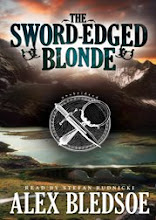
I'll be appearing on Saturday, October 11 at the Lemery House in Oregon, WI, as part of the Oregon Arts Festival. My reading is at 1 p.m., and I'll be doing selections from The Sword-Edged Blonde as well as previewing my vampire novel Blood Groove in honor of Halloween. It's a homecoming for me as well, since I did my very first reading almost exactly a year ago at the Lemery House. You can contact them through the link above if you need directions. Hope to see you there!
Monday, October 6, 2008
Interview: Albert Pyun, director of Road to Hell

Albert Pyun has been working steadily as a director since his 1982 debut, The Sword and the Sorcerer. He’s got over forty credits under his belt, and has worked with actors such as Dennis Hopper, Charlie Sheen, Burt Reynolds, Natasha Henstridge and Teri Hatcher. Now he’s putting the finishing touches to Road to Hell, a homage to one of my favorite films, Streets of Fire (see my reminiscence about Streets here). He was kind enough to speak to me about the project, and his memories of the original film.
Alex: We're both ginormous fans of Streets of Fire. Can you tell me about the first time you saw it? What's your favorite moment?
Albert: I first saw Streets of Fire at a Universal private screening before its release in 1984. I thought it was landmark cinema; it changed the language of film. I loved it from first frame, first note. My favorite moment was the telegraph scene and Cody arriving on an empty E train.
What was the reaction of the rest of this invited audience?
The screening reception was muted. I also saw the film when it opened and the theater was like a ghost town. Of course, I also went to the opening of The Rocky Horror Picture Show and there were six people in the audience. Both films found their audience eventually.
You've made a lot of films; what was the biggest challenge of Road to Hell?
Catastrophic loss of picture due to a defective hi-def camera. The flagship camera created a ghost that corrupted virtually every frame of the film. It continues to be challenging to correct every single shot.

This is your first time working with Michael Pare'. He was quite a bit younger the first time he took on a role like this in Streets of Fire; how did you approach getting the same sort of iconic performance from him now?
Michael and I have known each other since the mid-90’s. We talked over the years about making a film together. In the back of my mind I wanted to put something together for characters like Cody and Eddie [Wilson, from Eddie and the Cruisers]. I picked Michael’s brains about who they were for him and what it was like back then. Our plans began to solidify when our paths crossed in Estepona, Spain where Michael received awards for Lifetime Achievement and Best Actor. In a series of meetings prior to shooting Road to Hell, discussions centering around who and what he was back then enabled Michael to feel the emotions and relive the thoughts from the 80’s. His performance in Road to Hell, you see him reflecting back on the past, not just his past characters but who he was at that time. His performance reflects a richness and depth because of all he has lived since then.
When I talked to screenwriter Cynthia Curnen (see interview here) she said you and she took the climax of Streets of Fire entirely differently: she saw it as tragic, while you found it romantic. She said that might simply be a difference in male and female outlooks. Do you agree? Have you changed your opinion on that since working with her on the screenplay?
Characters don’t need to get together for a romantic film; that’s basically the different between our two perspectives. The moments where he had flashbacks of her singing and when he took out her worn out picture from his wallet indicate that she was always with him. A guy like Cody would not have told her he would always be there for her if he didn’t mean it.
But I don’t believe he would always be with her, except as the ‘one who got away’. If he had stayed with her she would have wanted to go back to rock and roll. He had to let her go because he held an idealized version of her in his head that she could never live up to. The real Ellen was too shallow and sour; she couldn’t be bothered with the feelings of other people. She never thanked McCoy for saving her; she exploited Fish when she kissed him to hurt Cody. Cody was all about Ellen and Ellen was all about Ellen. He let her go so she could fulfill herself. Even when she said she’d leave it all for him, it was to get what she wanted then but she would eventually have thrown or driven him away. For someone like Ellen, the unavailable is more attractive than the available. Deborah Van Valkenburgh’s character wanted him to hook up with Ellen in so she could stabilize him. His sister chose Ellen for Cody to keep him off the Road to Hell.
No, I have not changed my opinion but Cynthia may have changed hers.
(Note from Cynthia Curnan: I agree with Albert’s take on the characters and their motives. I would call it a romantic tragedy, but it’s still tragic through and through. I see that Cody’s idea of Ellen kept him believing in the possibility for redemption. From Carl Jung’s perspective Cody needed to keep Ellen in his psyche in an attempt to be a whole person. She provided the ‘anima’ in his unconscious necessary to maintain a measure of self-control.)
Thanks again to Albert Pyun and Cynthia Curnan for talking to me about Road to Hell. The film is in post-production and the release date is still pending.
Subscribe to:
Posts (Atom)