Monday, September 12, 2011
New blog! New website!
Go here to visit my new website and a new blog. This blog will no longer be updated after this post. See you in my new digs!


Monday, August 29, 2011
Meg Coburn, the forgotten action heroine
NOTE: THIS IS THE FINAL NEW BLOG POST AT THIS LOCATION. SUBSEQUENT BLOG POSTS WILL BE FOUND ON MY NEWLY REVAMPED WEBSITE AT ALEXBLEDSOE.COM.
I love action heroines. I've even put one in my next Eddie LaCrosse novel, Wake of the Bloody Angel. But my standards require, if not strict adherence, at least lip service to the laws of the natural world. That negates the whole concept of the the "ass-kicking sprite," wherein a tiny female character suddenly has the ability to overpower people (usually men) three times her size. No, my idea of an action heroine is someone like Xena, who has the physical size and strength to really do battle. And of course, the gold standard is Ellen Ripley in Aliens. She has no super, or supernatural, powers; she's merely tough, resourceful, determined and smart.
Which brings me to the great forgotten action heroine: Meg Coburn. Feel free to insert your own variation of, "Who?"

Meg Coburn, played by Mira Sorvino, was the heroine of Antoine Fuqua's 1998 film The Replacement Killers. Notable as the American film debut for Hong Kong star Chow Yun-Fat, it's a fairly simple story of hired killer John Lee (Chow), who decides he has a conscience after all. Meg Coburn is a forger he hires to make a new passport so he can return to China and protect his family. Unfortunately the bad guys intervene, putting Lee and Meg on the run together.
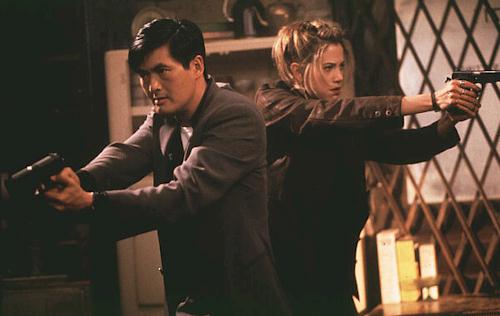
Two moments cement her appeal for me. One is visual: during the shootout in her first scene, she and Chow Yun-Fat arrive in the same room and drop into the same pose, only aiming in opposite directions. The image says it all: it's the mutual competence of equals. And in an action movie, if you're as competent as Chow Yun-Fat, you're doing all right.

The second occurs later, when John forces Meg at gunpoint to accompany him. She gives him a look that could freeze magma and says calmly, "Okay, if that's the way you want to play it. But when the gun is in my hand, we're going to have this conversation again."
There's a ton of other things that make Meg cool, but in some ways the things she doesn't do are more interesting. She never panics. She may yell, but she never once screams. She never stops trying to resolve the immediate situation. Yes, she's feminine and sexy, but it's incidental; there's only one fleeting shot I'd describe as actual Michael Bay-style pandering.
If you decide to see the film, seek out the "extended cut" DVD. Since it was made in 1998, when Hong Kong was about to revert to Chinese control, a crucial subplot was minimized in the theatrical release to avoid offending China and losing Chow Yun-Fat's hometown market. It's been restored here, and it fleshes out the motivations in a pretty substantial way.

It's obvious that we, the public, want different things from our heroines than from our heroes. It's why Supergirl dresses like a cheerleader, after all. But occasionally, amongst the pantings and leerings of the Bays and Favreaus, a real person slips through. Mira Sorvino's Meg Coburn was one of those. It's a shame more people didn't notice.
I love action heroines. I've even put one in my next Eddie LaCrosse novel, Wake of the Bloody Angel. But my standards require, if not strict adherence, at least lip service to the laws of the natural world. That negates the whole concept of the the "ass-kicking sprite," wherein a tiny female character suddenly has the ability to overpower people (usually men) three times her size. No, my idea of an action heroine is someone like Xena, who has the physical size and strength to really do battle. And of course, the gold standard is Ellen Ripley in Aliens. She has no super, or supernatural, powers; she's merely tough, resourceful, determined and smart.
Which brings me to the great forgotten action heroine: Meg Coburn. Feel free to insert your own variation of, "Who?"

Meg Coburn, played by Mira Sorvino, was the heroine of Antoine Fuqua's 1998 film The Replacement Killers. Notable as the American film debut for Hong Kong star Chow Yun-Fat, it's a fairly simple story of hired killer John Lee (Chow), who decides he has a conscience after all. Meg Coburn is a forger he hires to make a new passport so he can return to China and protect his family. Unfortunately the bad guys intervene, putting Lee and Meg on the run together.
Two moments cement her appeal for me. One is visual: during the shootout in her first scene, she and Chow Yun-Fat arrive in the same room and drop into the same pose, only aiming in opposite directions. The image says it all: it's the mutual competence of equals. And in an action movie, if you're as competent as Chow Yun-Fat, you're doing all right.
The second occurs later, when John forces Meg at gunpoint to accompany him. She gives him a look that could freeze magma and says calmly, "Okay, if that's the way you want to play it. But when the gun is in my hand, we're going to have this conversation again."
There's a ton of other things that make Meg cool, but in some ways the things she doesn't do are more interesting. She never panics. She may yell, but she never once screams. She never stops trying to resolve the immediate situation. Yes, she's feminine and sexy, but it's incidental; there's only one fleeting shot I'd describe as actual Michael Bay-style pandering.
If you decide to see the film, seek out the "extended cut" DVD. Since it was made in 1998, when Hong Kong was about to revert to Chinese control, a crucial subplot was minimized in the theatrical release to avoid offending China and losing Chow Yun-Fat's hometown market. It's been restored here, and it fleshes out the motivations in a pretty substantial way.

It's obvious that we, the public, want different things from our heroines than from our heroes. It's why Supergirl dresses like a cheerleader, after all. But occasionally, amongst the pantings and leerings of the Bays and Favreaus, a real person slips through. Mira Sorvino's Meg Coburn was one of those. It's a shame more people didn't notice.
Monday, August 22, 2011
Love, Revenge and Conan: What's My Motivation?
NOTE: THIS IS THE NEXT-TO-LAST POST FOR THIS LOCATION. AT THE END OF AUGUST, THIS BLOG WILL NO LONGER BE UPDATED. MY BLOG WILL BE FOUND AT MY NEWLY-REVAMPED WEBSITE, ALEX BLEDSOE.COM.
So there's a new Conan movie. And, if the previews are any indication, Conan spends the movie on a quest for revenge against the villain(s) who destroyed his village and murdered his family.
I won't go into how many ways this deviates from the original Robert E. Howard character (short answer: a lot). Instead, it got me thinking about screenwriters and how they think.
Consider the idea of "motivation." In movies, heroes are usually motivated by either love or revenge. And they must have a definite, solid, entirely personal reason for doing anything. I first became conscious of this trope watching The Skeleton Key, eighty percent of a great horror movie. Caroline, played by Kate Hudson, talks about how she became a geriatrics nurse after watching an elderly relative slowly die from Alzheimer's.

"Ah-HA! My motivation! Now I can act!"
Really? So she couldn't be a person who looked at possible careers and chose one that sounded good, or wanted to have a job with security, or any of the reasons most of us choose our jobs? No, there had to be a hyper-dramatic, entirely personal reason so that the audience will "sympathize" with her.
Giving Caroline such a background smacks of a "Screenwriting for Dummies" lesson. Sure, characters need motivation. But screenwriters seem unable to accept that "earning a paycheck," "providing for my family" or most crucially "the satisfaction of a job well done" are acceptable motivations. If the line "this time it's personal" doesn't apply, then it isn't valid.
Except that it is.
Here are two examples from the work of Oscar-winning director/screenwriter William Friedkin. In his 1986 film To Live and Die in L.A., FBI agent Richard Chance (CSI's William Petersen) sets out to bring down villain Rick Masters (Willem Dafoe) after Masters kills his partner. He even blatantly states, "I'm gonna bag Masters, and I don't give a shit how I do it." It's a textbook--well, a screenwriting textbook--character motivation. This time it's personal, and it encompasses both love (of the bromance kind) and revenge. It keeps an otherwise excellent movie from being truly great.

Conversely, in Friedkin's 1971 film The French Connection, New York cop Popeye Doyle (Gene Hackman) stays tenaciously on the villain's tail because, simply, it's his job. He needs no ulterior motive, nothing that says "this time it's personal." Through the course of the story it becomes personal, but only because the villain's success reflects badly on his professionalism. His ego is tied to his job, and he simply can't let the bad guys win. There's no hint that a childhood trauma caused this, or that a gangster (or Frenchman) once killed his family, or any sort of trite justification. It's realistic, and it's one of the elements that helps make the film a classic.

There are many useful things novelists can learn from screenwriters: get to the point, keep the action moving, craft witty dialogue and so forth. But this is one lesson they should skip. So make sure that you take away the right lessons, and stay grounded in reality where there are many other motivations besides love and revenge.
But....
As I read over the above, I realized my perspective is entirely one-sided. So for another point of view, I asked writer and USC film graduate Melissa Olson to comment on what I'd written so far. She responded:
"When I was at USC, nobody dreamed of being the next Michael Bay (well, maybe in the directing track(:). Everyone dreamed of telling the story they wanted to tell, to make the statement they wanted to make. But once you get out of school, the film industry is a tough business.
"Screenwriting is complicated, and in many ways it’s much more restrictive than novels. Maybe the screenwriters of Conan (there were three) didn’t want the movie to be about motivation; they wanted to get that out of the way and tell a different story. Shortcuts aren’t terrible things, they’re just easy ways out. Sometimes you gotta take one to get to where you want to go."
So there's two sides to this. What do you, the reader/filmgoer, think?
So there's a new Conan movie. And, if the previews are any indication, Conan spends the movie on a quest for revenge against the villain(s) who destroyed his village and murdered his family.
I won't go into how many ways this deviates from the original Robert E. Howard character (short answer: a lot). Instead, it got me thinking about screenwriters and how they think.
Consider the idea of "motivation." In movies, heroes are usually motivated by either love or revenge. And they must have a definite, solid, entirely personal reason for doing anything. I first became conscious of this trope watching The Skeleton Key, eighty percent of a great horror movie. Caroline, played by Kate Hudson, talks about how she became a geriatrics nurse after watching an elderly relative slowly die from Alzheimer's.

"Ah-HA! My motivation! Now I can act!"
Really? So she couldn't be a person who looked at possible careers and chose one that sounded good, or wanted to have a job with security, or any of the reasons most of us choose our jobs? No, there had to be a hyper-dramatic, entirely personal reason so that the audience will "sympathize" with her.
Giving Caroline such a background smacks of a "Screenwriting for Dummies" lesson. Sure, characters need motivation. But screenwriters seem unable to accept that "earning a paycheck," "providing for my family" or most crucially "the satisfaction of a job well done" are acceptable motivations. If the line "this time it's personal" doesn't apply, then it isn't valid.
Except that it is.
Here are two examples from the work of Oscar-winning director/screenwriter William Friedkin. In his 1986 film To Live and Die in L.A., FBI agent Richard Chance (CSI's William Petersen) sets out to bring down villain Rick Masters (Willem Dafoe) after Masters kills his partner. He even blatantly states, "I'm gonna bag Masters, and I don't give a shit how I do it." It's a textbook--well, a screenwriting textbook--character motivation. This time it's personal, and it encompasses both love (of the bromance kind) and revenge. It keeps an otherwise excellent movie from being truly great.

Conversely, in Friedkin's 1971 film The French Connection, New York cop Popeye Doyle (Gene Hackman) stays tenaciously on the villain's tail because, simply, it's his job. He needs no ulterior motive, nothing that says "this time it's personal." Through the course of the story it becomes personal, but only because the villain's success reflects badly on his professionalism. His ego is tied to his job, and he simply can't let the bad guys win. There's no hint that a childhood trauma caused this, or that a gangster (or Frenchman) once killed his family, or any sort of trite justification. It's realistic, and it's one of the elements that helps make the film a classic.

There are many useful things novelists can learn from screenwriters: get to the point, keep the action moving, craft witty dialogue and so forth. But this is one lesson they should skip. So make sure that you take away the right lessons, and stay grounded in reality where there are many other motivations besides love and revenge.
But....
As I read over the above, I realized my perspective is entirely one-sided. So for another point of view, I asked writer and USC film graduate Melissa Olson to comment on what I'd written so far. She responded:
"When I was at USC, nobody dreamed of being the next Michael Bay (well, maybe in the directing track(:). Everyone dreamed of telling the story they wanted to tell, to make the statement they wanted to make. But once you get out of school, the film industry is a tough business.
"Screenwriting is complicated, and in many ways it’s much more restrictive than novels. Maybe the screenwriters of Conan (there were three) didn’t want the movie to be about motivation; they wanted to get that out of the way and tell a different story. Shortcuts aren’t terrible things, they’re just easy ways out. Sometimes you gotta take one to get to where you want to go."
So there's two sides to this. What do you, the reader/filmgoer, think?
Thursday, August 18, 2011

Monday, August 15, 2011
Wednesday, August 10, 2011
Torchwood: For grownups, but not by them

Captain Jack Harkness, who is VERY pleased to meet you.
As part of our immersion into the universe of Doctor Who, the management staff at Chez Bledsoe has been watching the first season of Torchwood. Basically an English (well, Welsh) version of The X-Files, it's about a super-secret team who deal with otherworldly and paranormal dangers that beset contemporary Cardiff.
It doesn't take many episodes before you realize that the Torchwood team is its own worst enemy. Whatever the qualifications for joining, they seriously need to be rethought: in nine out of the ten first episodes, the primary danger is caused by a member of Torchwood (and in that tenth episode, nothing happens. Pretty much literally). The cast is interesting, the budget more than adequate, and the premise rich. So what's wrong?
Torchwood tries very hard to be cutting edge, especially in its approach to sexuality. The leader, Captain Jack Harkness, will, ahem, shag anything that moves--male, female, or other--as long as it's gorgeous. Computer whiz Tosh has a lesbian fling with an alien disguised as a human woman. Gwen and Owen, two team members, have an ongoing affair, and it's implied that uptight Ianto and Captain Jack have an occasional after-hours tryst. None of these are bad ideas, but they're also not thought through. The writers have people shagging for no apparent, logical reason except that it's titillating.
And that's when I realized what was fundamentally wrong about the show.
Torchwood feels like a fifteen-year-old's view of how adults act. Since most teenagers are obsessed with sex, so are the Torchwooders. But since most fifteen-year-olds don't have a lot of experience with sex, the relationships feel forced and phony, more like masturbatory fantasies than real encounters. Most teens have never held jobs, let alone jobs with responsibility, so they imagine worksite conflicts that simply wouldn't occur among highly-trained and supposedly elite team members. Instead of professionalism, we get playground arguments transposed to Torchwood HQ. Fights break out, but like playground fights, the next day they're forgotten--even when one team member threatens another with a gun.
I doubt that the writing staff on Torchwood is seriously fifteen years old. Instead they're likely the same kind of "talent" you see everywhere now: people raised on movies and TV who have gone into the industry at such a young age that they have no real life experiences to bring to their writing, only bits and pieces of other shows and movies. In some cases, such as the films of Quentin Tarantino, that's enough. Here it's not.
We'll probably continue watching the show, alternating it with Doctor Who. I've heard from multiple trustworthy sources that season 2 gets much better. And perhaps it does; after all, fifteen-year-olds do eventually mature, even if only a little bit.
Tuesday, August 2, 2011
Publishers Weekly reviews THE HUM AND THE SHIVER
In its review, Publishers Weekly calls my upcoming novel The Hum and the Shiver a "masterpiece of world-building." Hell, I'll take that.
Subscribe to:
Posts (Atom)